Review: The Aeronaut’s Windlass

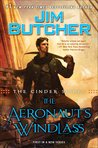
The Aeronaut's Windlass (The Cinder Spires, #1)The Aeronaut’s Windlass by Jim Butcher
My rating: 3 of 5 stars

Man, I wanted to love this one. I was ready to love it. I was prepared for it. Consider the background context: Jim Butcher absolutely dominates my list of “Most Read Authors” at a lofty 26 books. I’ve read almost everything that’s flowed forth from his pen and I use the word “flowed” in the most enthusiastic and positive sense: the summer I was introduced to Dresden was a reading feast as I plowed through eleven books with complete abandon. I still remember where I was when reading “Summer Knight,” for instance (I was camping on a beautiful mountain in southern Arizona, if you’re curious).

I remember picking up the Codex Alera books and being skeptical at first, but Tavi’s story drew me in and to this day, I consider the entire Alera series Butcher’s most underrated masterpiece. Alera showed me that I don’t need urban fantasy and wisecracking wizard detectives to enjoy his work.

I started this book in January. It proved to be slow going for me. I’d read a bit and I’d enjoy myself . . . but there was no hook. I’d put the book down for a few days and a week or two would go by as I read something else. I tried changing things up by going with the audiobook version during my walk to work each day . . . but more often than not, I went with a podcast instead. Eventually, I returned to the physical version of the book, mostly so I could finish.

Where do things go awry? The meeting with the Spirearch felt like a poor version of the First Lord from the Alera series and my feeling was the entire thing about “I can’t trust my guard because maybe traitors” was contrived to explain why these untrained kids were being sent off on an important mission.

For how prominently the aeronauts and the ship Predator featured in the title and the opening chapter, it’s quite surprising how little the airships actually figure into the book. Predator spends most of the story docked, with the action on “land” as it were. This was unfortunate, because the Predator and the airships were the most interesting and exciting aspect of the world. The battle at the end is suitably thrilling, but it’s such a small section of the book that by the time it rolled around, I’d be working slowly through the book for almost two months.

Also, the title bothers me. My understanding is that a windlass (in this universe’s context) is basically a barge or a ship that’s slow and weak. But Grimm (the presumed aeronaut in question) never has his ship turned into a windlass, so . . . where exactly is the windlass referred to in the title?

Other problems with the plot included the sudden and abrupt disappearance of the main antagonist, to the extent that I went back and reread a few chapters to make sure I didn’t miss a brief mention of the antagonist’s demise. Turns out, that wasn’t the case and the last few pages show that the antagonist managed to escape.

It was hard to tell whose story this was. Characters move around and disappear for long enough stretches of time that I can’t comfortably saw that it’s Grimm’s story, or Gwen’s. Maybe it’s really Bridget’s? But even she isn’t there for the finale, so who knows.

I’m almost 100% certain I can figure out the identity of the mysterious Enemy. Possible spoiler warnings, although I’m really just speculating wildly: considering the use of the word “unmake,” who’s willing to bet that the giant robot-thing is actually one of these deific Builders and that the oft-invoked “merciful Builders” aren’t quite so merciful after all?

I’m not a steampunk fan, so I can’t attest to how well (or not) this book will fare with fans of the genre. I’ve long been of the opinion that good writing will work regardless of genre and that good stories don’t need to rely on the genre conventions to be good, that the conventions are just fun embellishments or a form of adornment. Thus, I don’t consider my lack of familiarity with steampunk to indicate that “the book wasn’t for me” or “I just didn’t get it.” Hardcore steampunk fans may find otherwise, but that’s there business.

So, in the end, I’m left with a book that I picked through for two months. There are some good bits here, even some great bits; the airships and the chase at the end immediately made me want to go pick up a book about Victorian Era naval combat. You can see the familiar Butcher magic, you can grasp the pieces and see how they could come together to tell an epic story. But those pieces don’t come together here. It’s hard to see the characters as more than their archetypes: stoic captain, mad wizard, feisty aristocrat girl, etc.

I’m not going to write off the series yet. I recall how it took until the third Dresden book before I felt that the author had really hit his stride and found the magic, and so I’m willing to give the next adventure a look when it comes out. I think there’s potential. I don’t hate it when a beloved author works on other projects or other worlds. But on its own merits, I don’t feel the the aeronauts are taking flight and so we’re left with a book that’s merely okay. I liked it well enough, but I didn’t love it.

View all my reviews

Review: The Witcher: House of Glass

The Witcher: House of GlassThe Witcher: House of Glass by Paul Tobin
My rating: 3 of 5 stars

I’ve been completely sucked into the world of the Witcher since I started playing the third Witcher game a few months ago. Since then, I’ve tried to read everything I can to get familiarized with Geralt’s world and while I know there’s a series of novels waiting for me, this ended up being the first book that I’ve been able to read.

As video game graphic novels go, it’s okay. The story sagged somewhat in the middle and there were some basic assumptions about a certain character that I thought were going to be a plot twist, but ended up as something totally benign. Geralt certainly seems to have far more angst here than in the game and the continued self-references to “I’m a witcher, I don’t…” or “the witcher’s path is a lonely one” ended up getting a bit repetitive.

The art style was pretty cool, however, and there are some enjoyable moments. While the twist that I predicted ended up being completely wrong, there’s a pretty good reveal towards the end. Overall, though, I kept asking myself “why the hell would a master monster hunter allow himself to spend so much time in an obviously evil place?” Despite the fact that the titular House of Glass was full of cursed monsters and strange magic, Geralt didn’t seem to really mind that fact.

Final verdict: a fun, well illustrated graphic novel but somewhat underwhelming for my first foray into Witcher fiction, although the fact that this graphic novel appears to be a tie-in work to the game rather than the original novels might have something to do with that.

View all my reviews

Review: And Yet . . .

And Yet ...And Yet … by Christopher Hitchens
My rating: 4 of 5 stars

I don’t always agree with Hitchens’ views. In fact, I don’t think I even often agree with them. Despite a brief flirtation with the New Atheists a few years ago, I’m unwilling to consider myself more than a spiritual agnostic. I disagree with his embrace of war and military intervenionism. And yet. And yet.

Hitchens was one of the best goddamned writers of . . . possibly ever. Even when I completely disagree with his thesis, he’s delightfully readable. And I don’t disagree on everything. His more wry observations of life and culture and literature are a true delight and one comes away from a good Hitchens essay with the feeling of shared a drink with a brilliant and eloquent intellectual.

Of this final collection of essays, book reviews, and other short pieces, I will say this; I’m going to miss that voice. His thoughts on quitting smoking, getting healthy, and doing the physical makeover are bittersweet and poignant, the words given an unintended emotional gravitas when you consider how closely they were written before his own death.

This is more of a ‘completionist’ work of Hitchens writing than a ode to ‘the best of the best.’ Book reviews from books that are ten or more years old tend to feel dated, even for books that are remarkable. There isn’t really a true standout piece here and if you were new to Hitchens, this isn’t where I’d start. Despite that, there also isn’t anything that falls flat and nothing that isn’t interesting. It was nice to spend a little more time with a voice that I have missed and will miss. Overall, a very solid collection.

View all my reviews

Review: World of Warcraft and Philosophy: Wrath of the Philosopher King

World of Warcraft and Philosophy: Wrath of the Philosopher KingWorld of Warcraft and Philosophy: Wrath of the Philosopher King by Luke Cuddy
My rating: 4 of 5 stars

I picked this book up after a friend recommended it to me in the wake of my review of “Halo and Philosophy: Intellect Evolved.” While I think this concludes my foray into pop culture philosophy for a while, I did enjoy this book considerably more than “Halo Philosophy.” The nature of MMOs as shared simulated spaces (alliteration intentional!) invites several intriguing discussions, especially with regards to the metaphysical. Furthermore, so much of what makes MMOs interesting is the people that play them, and even though a first person game like Halo is also multiplayer, it’s really in the MMO space that one can seriously consider questions of character, identity, and self.

As you might expect, not every essay in this book is going to impress, but there are some true gems. In particular, the essays on the relationship between the character and the self really intrigued me. I’ve played a wide variety of characters over the year, including characters of an opposite gender. Thus, I paid particularly close attention to the essay written by a male player who, rather unintentionally, “toured” as a perceived female gamer for several months.

Is this a book I’d recommend to a non-WoW player? Eh, probably not. The authors generally do a good job of not relying “too” heavily on the game terms, but the largest appeal of these pop culture/philosophy books is how the content of your favorite game (or show, or movie, or whatever) can become the fuel for a philosophical discussion. If you’re not already a WoW player, I’m not sure why you’d be interested in picking up a book about it. That said, this is a very solid philosophy primer and if you’re an MMO player (of any game, really), you’ll find something to mentally gnaw on.

Quick aside: it was a little silly, but I really enjoyed the chapters presented in WoW’s “0/1” quest tracker style, as well as the “+3 to intellect” for completing the chapter. It was a fun bit of attention to detail.

View all my reviews

Review: Purity

PurityPurity by Jonathan Franzen

My rating: 4 of 5 stars

It was so very difficult to decide what to rate this book. Rarely has a book character just flat out irritated me so much . . . but irritated in a way that compelled me to keep reading. (For what it’s worth, I’m referring not to Purity, the main character, but Anabel, who shows up in one of the branching narratives. Purity herself was okay.)

This is often my experience with Franzen’s writing. Can I say that I really liked this book? If I didn’t like it, why couldn’t I put it down? Why did I race to finish it when my library’s due date edged closer? I’m convinced that this is indicative of a subtle talent and a prodigious skill, that I just. Kept. Reading. It’s still incredibly hard to know how to describe that feeling or even if I’d recommend the book. “I didn’t enjoy my time and yes, I was reading for pleasure, but it’s still a really good book?”

The story itself is classic Franzen, a world full of deeply flawed people. Purity herself breaks the mold from previous Franzen protagonists in that she’s actually a pretty likable person and her story is deeply compelling. The woven narrative between multiple characters creates a complex approach that I really enjoyed.

This book’s deepest flaw (aside from Anabel, who just drove me crazy with every page) is at that a book with sex and sexuality as a core theme, it’s a very unsexy book. I’m not sure if this is Franzen’s own writing style, if it’s intentional, or it’s due to the creepy Lolita vibe throughout the work, but I found myself skimming whenever clothes started coming off. Fortunately, that’s only a small percentage of the total book, so it wasn’t too much of a distraction.

I did roll my eyes at the line about how “Jonathan” just sounds like the name of a great writer. Really? Reeeeally?

And so we’re left with a flawed book that annoyed me more than almost anything I’ve ever read for my own enjoyment, but that I still read compulsively and could not put down. I don’t know what to make of that. I’m convinced that it means this work is brilliant. But it’s a weird place to be, mentally, and it makes for a hilariously awful blurb on the dust jacket.

View all my reviews

Review: Xbox Revisited: A Game Plan for Corporate and Civic Renewal

Xbox Revisited: A Game Plan for Corporate and Civic RenewalXbox Revisited: A Game Plan for Corporate and Civic Renewal by Robbie Bach
My rating: 3 of 5 stars

Sometimes a book presents itself as being about something and when you read it, you realize it’s actually about something else entirely. Other times, however, the book itself is pretty clear about its topic, but the reader’s perception is that it’s going to be about something else.

With the exception of the title and the stylish black-and-green color scheme that was the banner of the original Xbox (oh, how I’ve missed that look), “Xbox Revisited” is clear that it’s a business book, not a gamer book. It even says in the subtitle that it’s more about “corporate and civic renewal.” This focus is not hidden! And yet . . . and yet . . . it was recommended to me via whatever computer algorithms seek out those connections. “If you liked Console Wars, you’ll like this book!” So, while it might be a lesson about the recommendation process rather than a comment on the quality of the boo itself, I must admit I came into this book expecting an entirely different experience. And that isn’t really the book’s fault, in this case.

I was hoping for a “Console Wars” style narrative about the development of the Xbox, which has long been my favorite video game console. I was hoping to see more about how it was developed, what it was like in the trenches at the very beginning; in short, how it all happened. Unfortunately, “Xbox Revisited” focuses on the development only at the highest level and summarizes most of that story. Author Robbie Bach even says he isn’t much of a gamer and so isn’t equipped to provide a gamer’s perspective. Thus, while Xbox is the product that’s at the center of the discussion, the book isn’t actually about Xbox.

Instead, the focus is on Bach’s business management theory, which is called the 3P Framework. Not being a business manager myself, I can’t speak to how effective it might be. As a reader, it does feel like a bit of a stretch to take the business plan that worked for a video game console and apply it to the rest of the country. Your mileage may vary.

View all my reviews

Review: Tomb Raider Volume 1 : Season of the Witch

Tomb Raider Volume 1 : Season of the WitchTomb Raider Volume 1 : Season of the Witch by Gail Simone
My rating: 3 of 5 stars

The 2013 Tomb Raider reboot is one of my favorite games. I loved the revised Lara Croft character and I loved the focus on gritty survivalism. There was a bit of mysticism in the game, but it’s fairly subtle, certainly more so than the previous Tomb Raider incarnations. It’s an amazing game and easily the best reboot I’ve ever seen for a character as popular as Lara Croft is.

“Season of the Witch” serves as a sort of inter-quel story set between the events of Tomb Raider 2013 and the new game “Rise of the Tomb Raider.” In this story, Lara and the other survivors of the Endurance are trying to get on with their lives after their horrifying experience on the island of Yamatai. Unfortunately, weird things are happening which draw them back to the island.

The plot, unfortunately, is the biggest problem here. A story about trying to cope with the events of the island could have been pretty cool, but instead we’re drawn into a conspiracy surrounding the Solarii (the antagonists from the game). Wait, why is there a conspiracy about the Solarii? These business suit types are worshippers of Matthias? How is that possible? Based on the game, Matthias was a survivor who was trapped on Yamatai and formed the Solarii as an island cult so he could break free of its supernatural power. The game made it pretty clear that nobody had ever escaped from Yamatai prior to the events of the game. So where did these conspiracy guys come from? How did they know about the events of the island? Why would they worship a guy who, according to the game’s depiction, was really just a sort of feral survivor?

I appreciated how much the story tried not to be obviously supernatural, and the various things that occur are all suggested to be trickery, coincidence, or other artifice. Unfortunately, I could not wrap my mind around the idea that the homeless psycho who was the game’s antagonist was worshiped by a secret cabal. I also felt like “returning to the island” wasn’t really all that compelling.

Despite all that, it’s great getting to see Lara interact with the crew of Endurance more. It helps build on those relationships and makes her connections feel more meaningful. Overall, it’s a decent book with good characters but some deep plot and world building problems. It’s a good read if you’re really hungry for more Tomb Raider stories, especially since it’ll be a few years until the next game (presumably).

View all my reviews

Review: Halo: Escalation (Volume One)

Halo: Escalation (Volume 1)Halo: Escalation by Christopher Schlerf

My rating: 5 of 5 stars

Now this is a damn fine Halo story and an example of what I think should be the standard for other Halo graphic novels.

As mentioned in my “Halo: Initiation” review, this book does a much better job of introducing Sarah Palmer as a likable character, as not only is she devoid of much of the arrogance from her previous version, she even apologies to another character for being “unprofessional” at one point, which I think indicates the author has a better handle on her character. The cast is also much larger and more diverse, with a few different plotlines woven together. In particular, I really enjoyed Commander Lasky and Spartan Ray working together and their subplot was, I think, the most interesting.

I’m also a big fan of the Arbiter (he might even be my favorite Halo character, in fact) and so any book that gives him a role will make me happy, even if he’s mostly a side character.

But what made this book great for me, aside from the strong cast of interesting and likable characters, was that it wasn’t afraid to really dive into the plot and world building. We’re getting a look at the universe in the post-Covenant era, full of warlords and feuding and attempts at diplomacy. We see Sangheili that are becoming money-driven information brokers and Jiralhanae that are actually more than just berserker monsters (though only barely).

It’s a world that fills vibrant and alive, and focuses on a story that’s more than just “kill these guys and blow this thing up.” It even brings back a tantalizing glimpse at a story element from the somewhat forgotten game “Halo Wars” which wasn’t terribly popular, but one I really enjoyed. I won’t spoil the details here, but it was great seeing the UNSC Spirit of Fire getting mentioned again.

“Escalation: Volume 1” sets a high bar and I’m eager to see if Volume 2 can continue this level of momentum. Regardless of how the next book plays out, though, I would say this is a must-read for any series Halo fan. It has a bit of everything: action, plot, Spartans, aliens, and action, and it’s all wonderfully balanced. This is what a Halo graphic novel should be.

View all my reviews

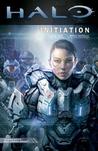
Review: Halo: Initiation

Halo: InitiationHalo: Initiation by Brian Reed

My rating: 1 of 5 stars

Based on her role in Halo 4, it seems like Sarah Palmer was intended to be the “face” of the new Halo generation and the Spartan-IVs. And on the surface, she seems like a pretty great character; she’s a Commander, which is cool, and she’s voiced by legendary voice actor and perennial fan favorite Jennifer Hale. Unfortunately, her characterization throughout the game is uneven and even somewhat unlikable, and those problems extend to this book which was meant to serve as an origin story for the character.

Palmer’s character is, for lack of a better term, just flat-out unlikable as a protagonist. It’s always great for characters to have flaws, of course, but those flaws do need to be tempered with characteristics that cause an audience to identify with the main character. Even worse, Palmer is uneven, at first disliking the Spartans for being “superior” and then lording that same superiority when she becomes a Spartan herself. There’s also the odd inconsistency in her rank and promotion: originally, her character was supposedly a lieutenant before she became a Spartan, which would make sense, but here she’s a lowly corporal . . . which means that, by the time of Halo 4, she’s jumped how many ranks in how short a time?

Basically, it’s just hard to root for her, and as this story is entirely focused on introducing us to her character, it drags the entire story down, even though the rest of the book is pretty decent. Fortunately, I’ve also read the next book in the Halo graphic novel line, Escalation Volume 1, and that story does a great deal to redeem Palmer’s character.

Thus, I’d say skip this one entirely. It doesn’t do anything for the character except make you dislike her, which is a huge problem for a backstory book.

View all my reviews

Review: Halo: Helljumper

Halo: HelljumperHalo: Helljumper by Peter David

My rating: 3 of 5 stars

For me, the best Halo stories are the ones that dive headfirst into the Halo universe’s deep well of lore. Most of the games barely scratch at the surface of this universe, only lightly touching or referencing the deep mythology. And that’s not necessarily a bad thing, since the action of the games themselves is so deeply satisfying.

“Helljumper” has the problem of trying to be more like the games than other stories. It’s very light on the story, focusing on the bond-of-brother-soldiers thing between Romeo and Dutch, two of the characters from Halo: ODST. Romeo was always my least favorite of the ODST cast, although to my surprise, he reads very differently than his game counterpart. Regardless, the focus of the book is largely on ODST action, kicking butt and killing aliens. Which is . . . okay, but the games handle this action-first focus far better.

Things like “the Knowing” which could be deeply interesting questions to ponder and investigate are instead reduced to a McGuffin that needs to be kept out of enemy hands or humanity is doomed, though we’re never told how exactly, as the McGuffin is blown up about four pages after it’s revealed.

Helljumper doesn’t really do anything wrong, but it doesn’t play to the strengths of its medium. Dutch and Romeo are likable and their bond is a good one, and I did like how the story ended on the question of whether they will transfer out or not. So while Helljumper doesn’t make any mistakes, it plays things too safe.

View all my reviews