Tabletop Gaming Weekend: Saturday Recap

It wasn’t supposed to turn into this three-day thing, you know? Friday’s gaming was a spontaneous thing, the result of one James Walter and the colorful box he carried to a work meeting and then to dinner right after the meeting. It was just there, you know? We had to try it. I can’t be blamed for that.

Saturday, though. For Saturday, I don’t have the luxury of that excuse, because I was enticed purely by one sentence: “who wants to play Dominant Species?” The answer was me. I do. I want to play this game. This is how day two of the gaming binge got started.

dominantspecies

Dominant Species is a strategy board game where you take the role of one of five different groups of animals and try to survive the encroaching Ice Age. It plays similarly to a tabletop war game, except that there’s really no war to speak of beyond this hilariously awesome combination of dropping glaciers on people and competing for resources.

The animals on offer are mammals, reptiles, birds, arachnids, and insects. Each one has a special ability: mammals are highest on the food chain (and thus win ties) and can survive extinction events. Reptiles can resist regression (which otherwise takes away the adaptations you need to survive). Birds can migrate more spaces than other animals. Arachnids have a particularly insidious power: they can preemptively eliminate other animals during Competition; they’re like tiny venomous assassins. Insects go first during each turn and can reproduce like crazy.

This was my second time playing dominant species and both times, I’ve picked the reptiles. They’re not the most powerful species, in my opinion, but I’m loyal to my scaled brethren. The goal of the game is to spread out across the board (which is arranged during play by placing hexagonal tiles to represent new terrain) and accumulate victory points while trying to survive. The various ways you can be eliminated are starvation due to lack of resources or competition, where other animals kill you off.

The real charm of this game comes from the massive amount of strategy. Each turn plays like this: there is a section of the board divided up into phases, with each phase representing a different strategic option. You have a limited number of tokens that you can place in on the phases to pursue those strategies. Some a limited in number: only three people can select the Adaptation, for example. You won’t be able to do everything. Once everybody has placed their tokens, each phase is resolved and you see who lives, who dies, who reproduces, and who runs away to a lonely corner of the map and tries to hold onto “Snake Mountain” for the entire game while everybody else kills each other or gets glaciated.

The glacier mechanic is particularly fun. The game starts with the center hex covered in a glacier. Each turn, whoever is first in line on the  Glaciation phase gets to place a new glacier tile anywhere on the board as long as it touches at least one existing glacier. This glacier kills off all but one animal of each species on the tile and also removes necessary resources from the board. It’s very fun steering the glacier towards your opponents. It’s very frightening when they steer it back towards you.

There’s a lot more strategy that goes into the game and you have to balance a lot in order to win. If you specialize on one resource, you might die off if that resource vanishes. On the other hand, if you engage in too much competition, you might not dominate enough areas to earn points. There’s a lot going on.

The game does have a rather long set-up time and takes a while to play. We didn’t hit the actual endgame by midnight and just ended up calling the game. I think part of this is due to the fact that both games we played, we were learning (we were all new the first game and had one new player the second game). Once you “get it”, things go a lot faster.

It’s a more complex game than King of Tokyo or Cards Against Humanity, but this is a core tabletop experience. A huge board, a lot of pieces, a ton of strategy: this is the kind of game that you’ll come back to again and again. I like how perfectly it captures the feeling of trying to survive as resources go scare, land changes, and then your land is overwhelmed by venomous spiders. The competition mechanic is more passive than other war games, but that makes for a nice change of pace.

It took up my entire Saturday night, but when you get right down to it, a Saturday night playing Dominant Species is a Saturday well spent.

Tabletop Gaming Weekend: Friday Recap

If you came looking for more religious rants or gun control laments, scroll down a bit. This is going to be about something else. I had sort of a “tabletop gaming binge” over the last few days. I hadn’t planned for that to happen, which is probably how all binges are explained after the fact. Anyway, here’s a brief recap on what I played and what I thought about it, broken down by day.

Friday: I played two different games on Friday, one that was a new experience and one that is quickly becoming a classic favorite in my book.

kot_box

The first game was King of Tokyoa game that can only be one of two things: a Japanese monarchy or a Godzilla-esque game about rampaging monsters fighting each other. I’ll save you time: it was the latter. King of Tokyo played a lot like Zombie Dice, in that you’re trying to roll a handful of dice to get preferred combinations like Attack, Healing, Energy, or Victory Points. The tricky part comes from the game’s battle system: you’re either “in the city” or “outside of the city.” Whichever monster is in the city accumulates points each turn, but is also the target for all the other monsters. It’s like a dice version of ‘King of the Hill.’ The game, not the Mike Judge cartoon.

I had a great time with the game, although I never managed to pull off a win. The mechanic is easy to learn and the monsters are really fun with names like Meka Dragon, Giga Zaur, the Kraken, and others. There are cards you can buy with the energy points to give your monster special powers which also provided more strategic depth.

Each game goes quickly, so you can fit in several rounds inside of an hour. It’s great as a starter board game or something to play between more complex ones, but it doesn’t have the legs to last an entire evening. It’s still a great buy and one that I’ll be adding to my collection when I get the chance.

cards-against-humanity2

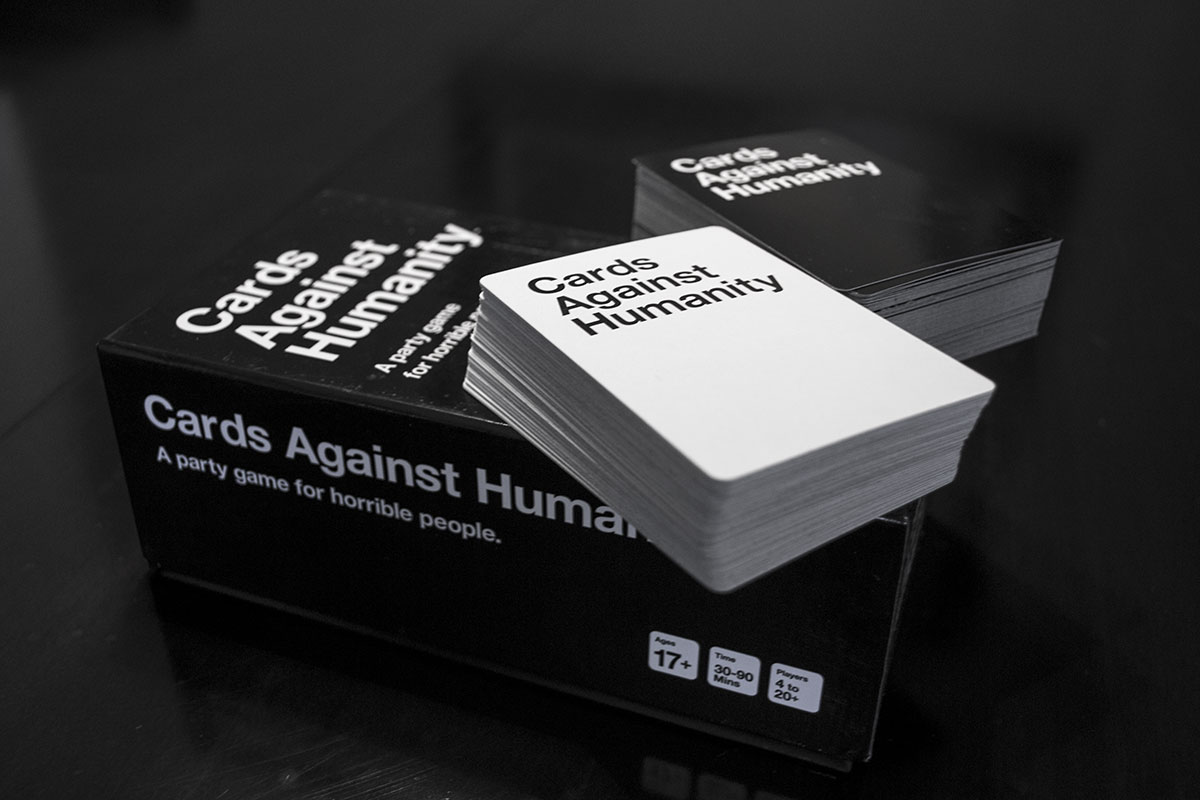
The second game we played was one that doesn’t need an introduction beyond its own description: it’s the party game for horrible people. Cards Against Humanity is your basic free-association card game in the vein of Apples to Apples. You have the black deck for your prompt, which will be something like “Science is now embracing the healing power of ____” and it’s up to you to fill in the blank with the cards from the white deck, which are all words like Explosions, Assless Chaps, or Apologizing. Whoever played the black card chooses their favorite and the person who played it gets a point. That’s the entire game.

This is the kind of game where you’ll learn a lot about your friends. I’ve been playing it for a while now and I’ve found that figuring out my friends’ respective “humor types” in a sort of Myers-Briggs-esque fashion seems to be the key to victory. Some of the humor types I’ve noticed are dark humor, scatological humor, word humor, and horribly inappropriate humor. I might elaborate on these brilliant insights in a later post.

It should go without saying that this is a game enhanced by alcohol. It’s also a game where you need to leave your inhibitions at the door. If there’s anything, and I mean literally anything that offends you on a deeply personal level, you may wish to consider other games, because there’s nothing off the table here. From Auschwitz to date rape to zoophilia, it’s all out there. Ye be warned.

The game will last as long as your friends do. I’ve found that we never play towards a set limit but rather reach a natural breaking point usually around midnight, which is usually three hours later than I meant to play. That should tell you something about how engrossing this relatively simple game can be.

Cards Against Humanity is a must-have in a gaming collection as long as you don’t mind the horrible, horrible humor. It’s the ultimate flexible party game: it can be played with four people just as easily as fourteen people, which isn’t something a lot of games can do. It also can make you wonder about how screwed up you are as a person, based on the things that you’ll laugh at. I found these revelations to be useful at dispelling any myths I might have had about whether or not I’m a decent person. Turns out, I’m not.

The Last Outpost

On a whim, I decided to watch an episode of Star Trek: The Next Generation today. There was no particular reason; I just found myself thinking about it and the fact that I’ve only seen bits and pieces of TNG over the years as a result of watching it on the arbitrary demands of cable television. How did we ever function without instant streaming? How could we follow the complex and nuanced plot development without watching back-to-back-to-back episodes on season DVD binges?

The episode I selected was season 1’s “the Last Outpost.” I think this was the fourth or fifth episode in the series and promised “the introduction of the Ferengi.” Now, I’ve seen enough Star Trek over the years to know about the Ferengi. I know Quark, even if Deep Space Nine was my least favorite series of the three that I watched primarily (TNG, DS9, and Voyager, although now Voyager would probably be more annoying to me). I thought I knew what to expect about the Ferengi.

Except, not really. I didn’t realize (or else had forgotten) that they were intended to be an antagonistic race, like the Klingons or the Romulans. This blew my mind to a group described as “18th century Yankee traders” were intended by the writers to be a major antagonist. Was the original plot of the social meant to be an allegorical battle between communism and capitalism? Actually, it probably was, now that I think about it.

Also, it seems that that standards for writing dialogue in 1987 for television shows were a lot lower. This can only mean that pop culture and the Internet have made us all smarter. There can be no other possible interpretation of this single piece of anecdotal data.

I was very surprised to see that the Ferengi were meant to be scary. I mean, they did have the sharp teeth, which always seemed to be a little weird for a comedic character in the later shows, but really? That’s your effort at a space monster? I really want to know the “behind the scenes” reasoning for this; it’s not like this episode was made befoer we knew how to make scary aliens. We’re already in a post-xenomorph world in 1987, we knew how to make scary aliens.

Okay, maybe the xenomorph was a little too scary for a television show, but still. There’s a middle ground between the most nightmarish avatar of destruction and sexual imagery ever imagined and a race of stunted, vaguely goblin things that bounce around too much, wave their hands around for seemingly no reason, and have all the terror factor of . . . actually, I can’t think of anything less scary. I was going to say the flying monkeys from The Wizard of Oz, but honestly, those were pretty creepy when I was a kid.

It was an interesting little experience. I might pick out more episodes and random and see what it’s like. I suppose I could watch all seven seasons (they’re on Netflix, after all), but honestly, I think that would probably take me the better part of a few years. We’ll see how it goes.