GamerGate Thoughts

I’ve held off on writing about GamerGate, but I might as well speak my piece. It’s not a very large piece.

I’ve followed Anita Sarkeesian‘s videos since her kickstarter. I follow her on Twitter. I haven’t always agreed with her views (in fact, I often find things I disagree with) but I think it’s really cool of her (and really brave) to be working so hard to have a discussion about gender issues in gaming. I’m really glad that she’s done her thing in the face of so much venom. I support her and developers like Zoe Quinn that have been driven out of their homes by threats from a very vicious, very vocal, very venomous group of people.

And that’s nothing new, nothing that many other reasonable people aren’t also saying. “Wait, Matt, you’re agreeing with the idea that it’s wrong to threaten to kill a bunch of people because a woman is talking about video games?” I know, it’s a totally radical opinion I have.

So here’s what I will talk about instead. Let’s talk about gamers. Let’s talk about us.

I’ve been a lifelong gamer. I had the dubious honor of being part of this group during the Nineties when Mortal Kombat hit the scene. You remember Mortal Kombat, right? Violence in games exploded in a big way after that one came out. Suddenly, everyone was talking about those violent video games. Violent games were forbidden in my house. I had to sneak over to a friend’s house to play Mortal Kombat. Considering how much of a super-geek I was growing up, this is literally the only thing I’ve ever done behind my parents’ backs. I played a video game. No drugs, no booze; just that one particular game.

I remember how it went, from Mortal Kombat to Doom to Grand Theft Auto. The issue of violence in games kept growing. Columbine happened. School shooters became a thing. And for most gamers like me, we kept hoping that it wouldn’t get any worse. We hoped that the public tide wouldn’t turn against games. We hoped they wouldn’t end up banned or strictly controlled. We just wanted to play.

Politicians like Lieberman and Pelosi and Hilary Clinton, likely looking to pick up family-first-morality credit, seemed to be in every article, saying how we need to take a closer look at these games, we need to control this. It might be a little ironic that I’m now a vehement liberal who’d vote for any of them, since back then, they were the enemies of gaming.

I remember when I was about ten or eleven, a friend whose parents worked for the local news station wanted to do a story on kids playing video games. At the time, I thought it was the coolest fucking thing in the world. They interviewed us (hilariously neglecting to get permission from my parents) and took footage of us playing games. I remember I had the first twinge of doubt when I offered to show them some of the non-violent games we had. I brought up Mario Kart and explained that it was my favorite, but they didn’t care about that. The reporter said something about how they already had enough footage of that kind of game. So all they wanted from us was the shooters.

I remember being so proud until the segment finally came on and it was an absolute nightmare for a kid who loved games so much. We were painted as being addicts playing murder simulators. Closeups of concentrated faces, hands moving over control pads. At the time, I thought it was because of how good it was at the game. When I saw the segment, I saw how we’d been lied to, literally lied to by the reporter and the camera crew. Fortunately for my younger self, the segment didn’t air until the last fifteen minutes of the evening news, so nobody I knew other than my parents ever saw it. I didn’t get picked on at school for it.

But honestly, I’m still pissed about it. I still disdain the channel that did it, although I won’t mention which news group it was. But I felt like they’d been out to get me. It was an us vs. them. Gamers vs. normals.

We didn’t want to bother anyone. We wanted to play our games and be left alone. As a kid who was picked on a lot, that was my refuge, a place where it didn’t matter that I was awkward and weird.

I remember Jack Thompson’s insane crusade and the mind-boggling amount of media attention he received. He was the universal enemy of all gamers. Even if you didn’t particularly like the games he railed against, if you were a gamer from 2003-2008, you probably had a negative opinion on Thompson. He was our collective nemesis and it felt like justice when he was finally disbarred as a lawyer.

That seemed like a turning point. Gaming had gone from this insular little thing that a few kids did to being everywhere. Suddenly, everyone was a gamer. We weren’t weird anymore, we weren’t different just because we liked games. Of course, I was well into adulthood as this magical change was happening, so at that point it didn’t matter quite as much to my life, but I could see how we were being treated by the general public consciousness. Famous people were gamers! Practically every single male in the world had a copy of Modern Warfare 2! And some females, too, although not as many. That game was a serious bro-fest. Guys that used to pick on me on the playground were lining up in front of me in the GameStop!

It seemed like gamers had proven the naysayers wrong. We weren’t violent, we weren’t maladjusted, we’d grown up and gotten jobs and become productive citizens and kept on playing. More murders have been committed because of something someone wrote in a novel than because of games.

And now, a few years later . . . here we are. Now we’re at the point where some gamers are threatening to commit the school shootings and rape and kill and literally, literally fucking prove every negative stereotype that we’ve endured since the beginning. How the fuck does that happen? How the fuck do you not see how fucking stupid it is to look at the stereotypes men like Jack Thompson heaped on us and say, “yeah, that’s a good fucking way to solve the issue of a woman talking about video games in a way that I don’t like?”

Here’s what doesn’t make sense to me is this; we grew up in a siege mentality. Gamers were used to being the bad guys, we were used to video games being the demonspawned corrupters of souls, the way movies, comics, rock music, etc. were once.

We were persecuted for being geeks and nerds by a hypermasculine social structure that didn’t reward intellectualism over athleticism, that didn’t value wanting to be different and do our own thing. And how, in some dark hilarious twist, instead of saying we’ll be better than that, we’ll be better than the fucking guys that made our lives such living hells throughout our youth that the only solutions seemed to be drugs, suicide or virtual escapism, now we’re just being the same as those fucking guys.

There’s only one explanation that makes sense to me. I can’t believe that any kid who grew up loving games and having that stigma would be doing this to someone else.

So maybe GamerGate and this systemic campaign of harassment and threatened violence against women in gaming is due to the fact that gamers aren’t the same little group of people anymore. Now gamers are everyone and that means that Gamergate isn’t simply a gamer problem, it’s one battle in a larger social struggle against male privilege and patriarchy and the way women are treated and depicted in this culture. That could be it. Maybe it’s not just gamers, but a very specific group of men in general. I don’t know that this would make me feel better about the situation, but it does make more sense.

Or maybe it really is a gamer problem. Maybe the problem really is us and today’s gamers didn’t heed the lessons of the past. Maybe they’re just ignorant of the history of what Columbine did to the hobby that we love so much, which is why they’d literally threaten that very same thing. Maybe we’ve forgotten what it was like to be the ones singled out for wanting to be who we were, for wanting to like the things that we liked. Maybe we’ve forgotten, taken the current status quo for granted, and now that someone else is daring to want to be part of it all, we’re turning on them like rabid beasts.

Or maybe it’s just a case of the echo chamber of the Internet and a small group of voices can be so mind-boggling, disproportionately loud. Maybe it’s the same group of MRA assholes that have been harassing people like Sarkeesian for years and their voices are just now getting particularly loud, their threats particularly egegrious. Maybe for every one idiot who supports the systemic terrorization of women in gaming, there are 99 other gamers who just want to keep quiet and play on.

Regardless, it’s a shitty situation that we’ve found ourselves in. It’s shitty and it’s depressing and it makes me wonder if maybe we weren’t better off with Jack Thompson and his one-man crazy crusade. Because at least when he was around, saying his crazy things, we could just shrug and say, “man, can you believe what this guy is saying?”

Because right now, all I can do is put my face in my hands and say, “man, can you believe what gamers are saying?”

No. I can’t.

I really, really can’t.

Azeroth Choppers Review

You might have noticed that I spend a lot of posts talking about motorcycles. I also spend a lot of posts talking about video games. Thus, it seems natural that I’d have an opinion on Azeroth Choppers, the web series that follows (some of) the Orange County Choppers crew as they make two bikes themed for World of WarCraft.

You’re right, I do have an opinion. Buckle up (or put your helmet on, since motorcycles don’t have seatbelts) and get ready, because I’m going full-bore nerd here.

So here’s the basic idea for the uninitiated who don’t play WarCraft. The (former) Orange County Chopper guys build a bike matching the theme for the two different player factions, the Alliance and the Horde.

If you ever watched Orange County Choppers when it was on the air, this was their whole schtick. A client would request a custom chopper to promote .  . . whatever and the crew would spend the entire episode designing it and building it and then finally showing it off to the client.

The early seasons were very much in the same vein as all the other “look at this cool job” reality shows. And to be honest, it really was cool seeing how custom motorcycle design works.

But along the way, the Reality Show Curse took hold, possibly because aside from the different designs, once you’ve seen how their build a bike a few times, the formula stays pretty much the same. So they decided to focus on the drama of bike building, which meant lots of arguing, lots of squabbling, etc. You can probably guess what point I stopped watching.

So now the makers of WarCraft decide they want custom bikes. And they want their players to vote for one of the bikes to be turned into an in-game item and given to players of that faction for free.

So when it’s all said and done, one half of the player base will get a free motorcycle in the video game that’s based on the real motorcycle that was built.

This is an incredibly terrible idea.

More specifically, it’s an incredibly terrible idea because of Blizzard’s own decisions about the value of digital content.

Collecting “mounts” is a big aspect of World of WarCraft. Mounts are exactly what the name implies: they are things that you can ride so you move through the game world. In the early days of the game, mounts were limited to things like horses, wolves, tigers, and other things that could increase your travel speed on the ground. Eventually, more fantastic mounts like dragons and phoenices were added so that players could fly through the skies.

They even added a motorcycle at one point.

The reason why mounts are a big deal is that they’re some of the game’s biggest status items. They’re the most coveted. Armor and weapons are cool and improve your character’s power, but those things don’t persist in value. You replace them constantly. Today’s legendary sword is tomorrow’s useless trash.

But mounts are pure vanity. Technically, your first ground mount and your first flying mount are the only two mounts you’ll ever need. There’s no real difference between flying around on a winged eagle-lion or a dragon, except that a dragon is amazingly cool looking. So everyone wants one.

Mounts are usually hard to get, rare items that require extraordinary luck, time, or both. And then Blizzard decided to starting selling them.

The ability to buy a mount debuted relatively late in WoW’s lifespan, during the Wrath expansion. Prior to that, the only way to get a mount was to play the game and earn it.

The first “for sale” mount was the celestial steed, often denigrated as “the sparkle pony.” For $25, you could equip your characters with a sort of glowing translucent blue version of an astral horse. The horse could also fly.

Keep in mind that this horse doesn’t fly faster or anything. It’s just like every other flying mount, including the other flying horses already in the game. You’re not getting a material advantage by buying the sparkle pony. It’s purely a vanity item, just like every other mount.

They’ve added more mounts since then, including a vampire bat, a dragon that changes colors (which I did buy, to my shame, because I’m a sucker for dragons) and most recently a two-headed dragon-ish thing (that I didn’t buy because of the incredible buyer’s remorse I had over the first dragon). All of these mounts are functionally just new models. New things to look at.

On their own, they don’t cause any harm, except for the buyer’s remorse factor that I felt. They don’t hurt the game. Ignore them if you don’t want one. They’re optional.

Here’s why this Azeroth Choppers thing is a stupid idea.

Throughout the entire course of the game, the developers have created the idea that mounts have value. Mounts have value. Initially, that value was represented by playing time and dedication. You had to run the toughest encounters, kill the toughest monsters, or get incredibly lucky to even have a chance at one of these.

Or you had to invest lots of time getting in-game money to buy one. It all worked to create the perception of value. More rare mounts were perceived as more valuable, simply because of that rarity.

The ability to spend actual money to buy a mount further reinforced this perception that mounts have value, especially because now they literally have value. $25 dollars per mount. If you’re an OCD mount collector, get ready to spend over a hundred bucks . . . you know, in addition to playing the subscription fee and all.

Mounts have value. They have value in terms of time, luck and/or actual money. This is the system that has been in place since the game first launched in 2004 (although I think mounts weren’t actually added to the game until 2005, it’s hard to remember. Doesn’t matter, they’ve been around for a long time).

And now we get to the heart of why Azeroth Choppers fails at its objective.

The idea was that although two motorcycles would be created, only one would be added to the game. That motorcycle would only be available to characters of that particular faction.

For the players of the other faction, they’ll get zero. Zip. Zilch. Nada.

Sure, they could create a character on the other faction if they really want a free motorcycle so badly, but let’s be realistic. Most players have a group of players that they’re invested in. Playing both sides isn’t very common. You have your favorite character, you “main” character. And that character may not be on the side that gets a free motorcycle.

So half the players get something and the other half get nothing.

What does that accomplish, exactly? The players on the losing side feel shafted. They feel shafted specifically because the entire concept of the mount is built around the socially engineered concept that mounts are valuable. Mounts are $25 dollars.

So you, winning player, here’s a free $25 dollar thing. Enjoy. But you, losing player? You get nothing. Have fun.

This is a terrible fucking strategy. It would have been less shitty if mounts weren’t constructed around this idea of value, but they are. If the winning motorcycle had been made available to both sides, it would be less shitty, because then everyone gets something equally. Sure, the losing faction doesn’t get “their” motorcycle but they’re still getting $25 worth of value.

Most reactions seem to be that there’s no way Blizzard will enforce the competition aspect of this whole stunt. I’ve read a lot of opinions that suggest the winning motorcycle will be free to that faction and the losing one will be available in the real-money store, presumably for $25.

If anything, that idea is even stupider, a tax on the players who aren’t on the winning side. Not to mention; how many people really want to spend $25 on something that says, hey, remember that your side lost. This whole competition idea completely damages the perception of value for the item that they themselves spent money to build!

This entire thing was supposed to be a publicity stunt, which it was. Presumably, it was supposed to generate good publicity . . . which it didn’t. The concept was flawed from inception. If they really intend not to give everyone a bike, their own model of perceived value bites them in the ass.

If they change their minds and say, sure, bikes for everyone now, why the hell didn’t they just do the entire promotion like that from the beginning? The entire spectacle is based around the idea that “one bike goes into the game” and “the losers get nothing.”

Yes, the game is built around conflict. But now that you’ve taken that perception and turned it into something tangible, it’s no longer fun. Now it just feels mean-spirited. It doesn’t matter that Blizzard didn’t choose the winner, the players did. For players of the losing faction, they get to be exactly that. You guys are the losers. Enjoy playing your game, losers. Have fun being losers.

That’s . . .  not really a great feeling to instill in half your customer base.

On one final note: it really annoys me to hear everyone referring to the three-wheeled motorcycle as a “bike.” A three-wheeled motorcycle is not a bike. It’s a trike.

This annoys me both as a rider and as a fan of the English language.

Facebook Bought Oculus Rift

The Oculus Rift was one of those things that made me feel like a revolution in gaming was on the horizon.  I admit that lately, I’ve been feeling a little unenthused by what’s out there. I haven’t felt a compelling reason to buy any of the new generation of consoles. I’m mostly playing MMOs, one of which originally launched in 2004. Everything coming out lately just feels like it’s been more of the same old thing.

I wrote about the Oculus Rift before and how excited I was by the potential. The prospect of a true VR experience is still the main reason to be excited even though I haven’t yet been able to play with the machine without getting terrible motion sickness. I’m hoping the final product with correct that. Almost as exciting, though, was the way the Oculus Rift was brought into the world: it began through Kickstarter. It was funded by the excitement of its fans and developed on the back of that grassroots-level enthusiasm.

And then Facebook bought them.

I understand how the developers could be willing to sell their baby to the megalithic Facebook. If somebody waved $2 billion dollars in my direction, I would do the same thing. I might even do it for less, like say . . . $1 billion. There’d be room to negotiate, is my point.

Less exciting, however, is the idea that the Oculus is now in the hands of Facebook.

Yes, I use Facebook. This blog will get a large portion of its traffic from the automatically generated link that appears in my Facebook feed. I use it but I don’t love it. I don’t even like it.

I use it because that’s what’s there and it’s where people are. It functions for its purpose and it has enough inertia behind it to prevent other, better products from gaining much ground (Google+ would get my vote, even though nobody uses it very often, including me).

Notch, the creator of MineCraft, sums up his own feelings about this disappointment quite well:

Facebook is not a company of grass-roots tech enthusiasts. Facebook is not a game tech company. Facebook has a history of caring about building user numbers, and nothing but building user numbers. People have made games for Facebook platforms before, and while it worked great for a while, they were stuck in a very unfortunate position when Facebook eventually changed the platform to better fit the social experience they were trying to build.

Don’t get me wrong, VR is not bad for social. In fact, I think social could become one of the biggest applications of VR. Being able to sit in a virtual living room and see your friend’s avatar? Business meetings? Virtual cinemas where you feel like you’re actually watching the movie with your friend who is seven time zones away?

But I don’t want to work with social, I want to work with games.

I should note that this doesn’t mean the Oculus Rift is ruined forever. It might still be a great platform. It does mean that I’m considerably more skeptical now than I was before I read this announcement. Facebook isn’t a company that inspires a lot of confidence in me. Like Notch says in his post, their motives are unclear and shifting, their platform has been unstable, and there’s nothing about their history that says “yeah, I trust them to get this right.” Every indication of Facebook seems to indicate that it’s been a wild success in spite of itself.  One needs only look back at the Facebook IPO debacle for a reminder.

The fact that the Oculus Rift sold for $2 billion dollars before it even hit the shelves sits poorly with me for another reason. Let’s go back to 2006.

The Nintendo Wii hit the world with the force of a hurricane. I was still working at GameStop at this time so I endured the full wrath of desperate consumers looking to buy the system for the holidays. I remember how motion controls were suddenly the thing in gaming and Microsoft and Sony scrambled to have their own answers.

But eight years later, what’s the state of motion control? A gimmick past its prime, if sales of the Wii U are any indication.

What happens to VR if the Oculus Rift doesn’t live up to its $2 billion worth of expectation? Will any of the competing products on the horizon be there to take up the crown or will the disappointment set VR gaming back another decade?

I think it would have been better for gaming, for VR, and for the Oculus Rift itself is this hadn’t happened. It would have been fun to see how far the grassroots momentum generated by the Kickstarter could have carried this thing.

I guess we’ll never know.

Virtual Worlds And Dreamscapes

I tend to have pretty intense dreams. Somewhat arrogantly, I attributed this to being a writer. “Well, of course my dreams are intense and vivid,” I’d think smugly to myself. “Mine is a fertile and creative mind, capable of spinning entire worlds into existence.”

I might be a bit premature in patting myself on the back for my wonderful, creative mind; it turns out my vivid dreaming might just be due to the fact that I play a lot of video games:

In her most recent paper, published in the latest issue of Dreaming, Gackenbach and her colleagues further solidified a key earlier finding: that so-called “hardcore” gamers were more likely than their peers to experience lucid dreams. Gackenbach first reached that conclusion in 2006, after noting that gamers and lucid dreamers both displayed traits like intense focus and superior spatial awareness in their waking lives. Indeed, when she surveyed 125 gamers and non-gamers on the frequency with which they experienced lucid dreams, Gackenbach found a strong association between the two.

Gackenback defines “hardcore gamers” as having “regular playing sessions of more than 2 hours, several times a week, since before the third grade.” Yeah, that’d be me. I do have lucid dreams fairly often, maybe on average of 2-3 per month.

Here’s the other thing from this study that really tracks well to my own experience:

And Gackenbach’s findings don’t stop at lucid dreaming. She’s also noted in other studies that some heavy gamers seem to be non-plussed by dreams that would qualify as nightmares — namely, those that present frightening or threatening situations. In fact, gamers seem to readily take control over (and even enjoy) such unpleasant nighttime illusions. In other words, while a non-gaming person might wake up in a cold sweat, a gamer would simply carry on with their slumber.

It’s actually a bit of a relief to learn that this might explain the frequency of dreams that would qualify as nightmares as well as my typically blasé reaction to them. Again, this was long something I attributed to creativity, but if it’s due to my predilection for virtual worlds, that’s cool with me.

One thing I’m especially curious is to see what effect the upcoming Oculus Rift has on the ability for games to influence dreams. I’ve played a few tech demos on an Oculus Rift dev kit. Dread Halls was my favorite. Even though the graphics were fairly dated, it was a terrifying experience and I legitimately screamed when I saw my first monster.

The strangest part is that I now have fully formed memories of being in a place that I know doesn’t exist. I can remember moving down the hallway and peeking around the corner to check for monsters. I can remember running. It’s very much like remembering a place that exists only in a dream, except that my recollection is flawless.

I can’t wait to see what prolonged exposure does to my dreams.

The Best “Rise And Fall” Stories Of The Video Game Industry

When it comes to the video game industry, I have a weakness for “inside-baseball” style stories. Obviously, it’s better  for everyone when a company completes its development cycle and successfully releases its game. The only problem with all the successes is that few of them make for interesting reading. “We all worked very hard and then we released our product” is rather dull, even if it’s the goal everyone strives to attain day after day.

No, what makes a good “inside the industry” story are the companies that don’t make it; the ones that go down in flames. What goes on in those companies is as interesting to an observer of human behavior as it is to speculate about their products and what could have been.

Obviously, taking an interest in this topic has to come with an understanding that these were not characters in a book, but real people whose lives and livelihoods were affected by these events. Nevertheless, the collapse of these two companies was, in my opinion, nothing short of spectacular. I think it’s worth revisiting the stories of their respective demises.

Ion Storm
Article: A hardcore elegy for Ion Storm (Salon.com)
Original publication date: Jan 2, 2002.
Choice quote:

No place was more aptly named. John Romero was the focus of this industry love-hate affair: his popular games and extravagant lifestyle made him an icon in the industry. But with great success came great antipathy, not just for John, but also for many of his employees.

What started out as a video gamer’s heaven turned into a public hell of walkouts, firings, lawsuits and litigation. Chat rooms and Web sites devoted daily commentary to analyzing, bemoaning or laughing at every move John made. He went from being one of the industry’s most respected figures to one of its most pilloried. Few bothered to defend him or the company.

 38 Studios
Article: End Game: Inside the Destruction of Curt Schilling’s 38 Studios (Bostonmagazine.com).
Original publication date: August 2012.
Choice quote:

Schilling’s harshest critic in the online exchange was Bill Mrochek, the vice president of online services, whose wife required a bone marrow transplant at the time their healthcare disappeared. “Are you going to admit that your stupid hubris, pride, and arrogance would not allow you to accept that we failed — and help shut it down with dignity?” he asked Schilling.

Mrochek was talking only about 38 Studios’ dramatic final weeks, but as interviews with Schilling, members of his former staff, and others associated with the company show, he might as well have been describing 38 Studios from the moment that Schilling — lacking any business experience, but full of the same confidence, bravado, and determination that made him a baseball legend — decided he could build a billion-dollar video-game company.

If you have any other stories of game developers or publishers collapsing in a dramatic fashion, feel free to share your links in the comments. I’d be interested in seeing what else is out there.

If you’d like an even deeper look at Ion Storm’s demise, I recommend Masters of Doom: How Two Guys Created an Empire and Transformed Pop Culture by David Kushner. It’s a fascinating read.

Saints Row The Third: A Friend And A Song

A few months ago, one of my friends had a “house cooling party.” We said farewell to his old place, shared drinks and food, and helped ourselves to the pile of stuff he’d laid out to give away. Amid the expected books and DVDs, there were a few Xbox games in the pile. This explains why I picked up a copy of ultra-thug GTA wannabe Saints Row the Third. It’s not something I ever would have purchased otherwise.

I’m not really a fan of Grand Theft Auto or any of its sequels. I played San Andreas for a little while specifically because censors were telling me not to, but I didn’t love the game. I enjoyed the freedom to wander around and create destruction, but games are ultimately about story and character interaction for me and GTA games don’t really seem to have that.

Regardless, I received a free copy of this Saints Row game and decided to give it a shot. After all, free game! So what happened?

It’d be difficult to say that Saints Row the Third has a good story. The story is very strange and very, very irreverent. For a game that starts out about thugs and gangsters and such, you realize somewhere between the zombie invasion and fighting tanks in midair in a tank that fell out of a plane that this game is a bit of a subversion. Usual story conventions don’t really seem to apply here. The motivation for anything in the plot seems to be “do as much cool shit as possible!”

So you have your gang of fellow thugs and criminals to accompany you; you can also design your own character, male or female. One thing I particularly liked is if you create a female character (which I did), she’s in charge of this gang of criminals and nobody says anything about it. Nobody calls your gang out for being led by a woman. It’s not weird or remarked upon. It just is. Your gang’s color is purple whether you are male or female.  It’s all surprisingly refreshing.

Anyway, there’s a scene early in the game where you and your fellow gangster Pierce are driving to a destination to complete a task. Usually, on these sorts of drives, the characters will talk about plot things. You know, something to get the story rolling. I wasn’t expecting to come across anything particularly poignant or meaningful.

Here’s a YouTube recording of the scene. The game play of crashing into cars is irrelevant to my point; the thing I want to focus on is the dialogue. Warning: NSFW language is present throughout.

What’s going on here? This isn’t plot dialogue or exposition. Pierce says, “we need some driving music,” flips on the radio, and then suddenly Pierce and my character are singing along together while they drive.

That’s powerful. Do you know why? Because suddenly I feel like Pierce is my character’s friend. They’re having this moment together. It’s not a romantic moment. It’s just a moment between friends. It’s a moment that creates a bond and it only struck me with how powerful that moment was once I realized how few games try to do this.

Listening to Pierce and my character sing, laugh, and tease one another forged a bond that was with me for the rest of the game. It informed decisions I made later on when certain choices were presented. It was a small moment, a silly moment, and yet it was one of the most powerful I’d ever experienced as a gamer. It’s so rare for games to do anything like this.

“Here is your friend,” the game tells you. “You care about this person.” Rarely does the game try to give you a reason. Rarely do you have a moment of two characters interacting in a way that friends would. But this game, with all its ridiculousness and irreverence for taking things seriously, nevertheless manages to pull off a powerful and serious bit of character building with nothing more than a bit of Sublime and two characters singing along together.

Video Game Heroines In 2013: One Step Forward, Two Steps Back

Seems like 2013 was a pretty good year for video game heroines. We saw Lara Croft go from being the quintessential video game pin-up character to something resembling a real human woman. Compare:

laraoldandnew

What’s better about the new Lara Croft? Where to start? She’s wearing actual clothes. She’s wearing pants, which, you know, makes sense for an adventurer. Her proportions are realistic! There’s still a sexy vibe about the new Lara, but that’s not the point of her new character. Her design speaks to the kind of athleticism you’d expect from someone who goes on adventurers and climbs and hikes and all that. In short, while she may have sex appeal, she’s definitely not a sex object anymore.

I think this is a step in the right direction for video game heroines. It’s a sign of progress! We’re moving in the right direction, at long last. We’re finally recognizing that 45% of gamers (at least) don’t have a Y-chromosome. 2013 has been a great year in this regard!

And then this happened:

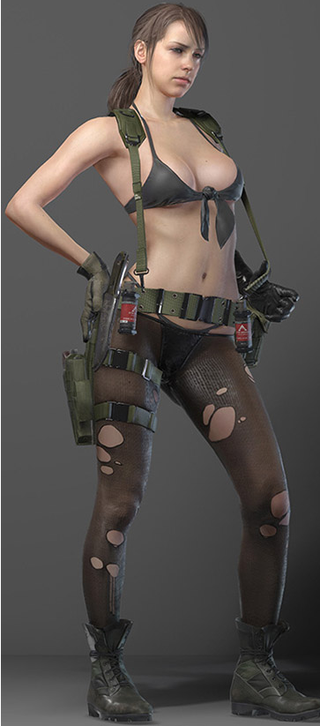
Meet Quiet, the new protagonist for the upcoming Metal Gear Solid 5:

quiet

Sigh.

Underwear? Check.

Prominently displayed cleavage? Check.

Impractically sexy clothing damage? Check.

I can’t think of anything else to say about her character based on this design. She has the same distant, snarky expression of the Lara Croft from the previous decade, the one that says, don’t worry, I won’t be ruining the sex appeal by showing any actual emotion like fear, anger, or determination.

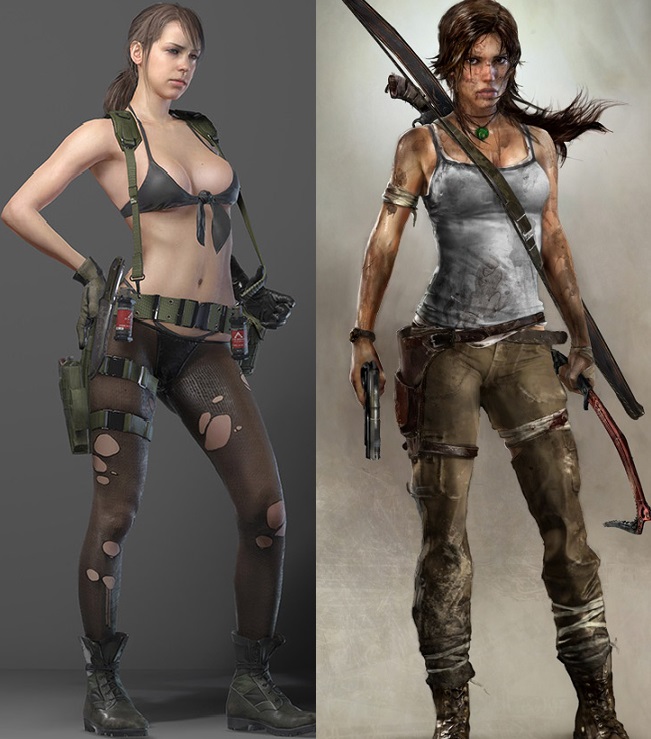
True, this is only concept art and her actual personality might be very different in the final game. On the other hand, I think you can tell a lot by looking just at the concept art. Let’s compare Quiet to 2013 Lara.

laraquiet

Aside from the fact that she’s basically in her underwear, we can see that Quiet’s leggings are torn in several places. Is this supposed to suggest that she’s been through a harrowing survival experience? Maybe, but if so, the fact that everything else about her appearance is flawless suggests that actually, she just likes to wear leggings with big holes in them. She doesn’t look like a warrior. The gun-belt doesn’t communicate anything of the sort; if anything, it just sends the entire design further in male fantasy land. Chicks with guns + underwear = hot.

With the two character designs side by side, you can really see the difference. Lara looks like she’s been through a survival experience. She’s covered in dirt and grime, with several makeshift bandages here and there. Her clothes are torn, but not in a way that’s strategically sexy. Is she still unrealistically beautiful for someone in a life-and-death situation? Yes, absolutely. In “real life,” she’d likely be a lot worse off. But we’re talking about video game protagonists here; male and female alike are allowed to have the “attractive” attribute, as long as that’s not the primary attribute for the character. As soon as you have a character parading around in their lingerie instead of actual clothing, you’ve sacrificed characterization for sex appeal.

Because, let’s be honest: you know what’s really fucking useful when you’re fighting or surviving in the jungle?

POCKETS.

Pants have pockets on them. Hell, even shorts have them. You know what doesn’t have any pockets? Bikinis with ripped lingerie leggings. Huh, imagine that.

Basically, it comes down to the fact that when I look at Quiet, my first thought is “stripper.” When I look at Lara, my first thought is “survivor.” I’m not a woman, so I can’t say which character design would give me a feeling of female empowerment, but I do know which image is more heroic to me. I know which character I’d want my daughter to look up to.

Regardless of hypothetical scenarios, I know which kind of character I enjoy and appreciate more. Evidently, that taste isn’t mainstream yet. I thought we’d come further along than this. Alas.

One Word At A Time

After yesterday’s post, I spent the rest of my time thinking how do we fix this problem? Game culture, despite how tongue-in-cheek we might use the phrase, is a real thing now. It’s as real as popular culture in its ability to influence. We have cultural conventions now. We have cultural language.

It’s hard to describe how game culture came to be without resorting to dramatic, overblown language describing the strife that it emerged from. While the “violence in video games” discussion won’t ever truly disperse, I think we’ve come a long way from the days of Jack Thompson and his ilk. They’re not gone, of course, but for the moment, they’ve been defeated. Someone will be along eventually to take his place, but hopefully not for a while.

We won that round, at the low cost of developing a reflexive siege mentality that is one of the causes of the dickwolves thing I wrote about yesterday. We’ve traded one problem for another, which isn’t as cynical as you might think, because that’s basically how progress works. The only people who don’t have problems are dead. Dead people might have problems, too, that we just don’t know about.

So, you know, we’re doing okay, really.

Regardless of my inability to commit to a side on the dickwolves debacle, there are plenty of other instances of misogyny and rape culture in game culture itself. Nobody can rationally dispute that fact, regardless of where you come down on the dickwolves issue. The question we should all be asking ourselves is, as I said above, how do we fix this?

While I’d love to say I came upon the solution in a flash of brilliance, the truth is this was a comment made on yesterday’s dickwolves post. From my friend therationalpi:

Ya know, I used to say “rape” a lot. In videogame parlance, “rape” is just another way to say “beat on.” Like, instead of saying, “The red team really beat the blue team that game.” you might say “The red team really *raped* the blue team.” It’s a pretty common expression, that I used to use very casually.

Then I realized how much that word can bother people. For some people it brings up really negative memories and emotions. After realizing that, I stopped being so insensitive and slowly excised that word from my vocabulary. I never thought that actual rape was anything to joke about, but my vocabulary didn’t reflect that sentiment. So I changed my vocabulary.

This. This is how we start fixing things. Small changes. A piece at a time. I believe this will work, because this is exactly analogous to my own experience.

Confession time: I wasn’t always the male-feminist-ally-vegetarian-idealist that I style myself as today. I was a gamer a lot further back than I was any of those other things. I engaged in my share of smack-talk. I used the word “rape” in video games liberally and I used it as recently as 2005, when I was deep into the PvP scene in World of WarCraft.

I remember the first moment somebody called me out on using that word. It wasn’t much, just an admonishment that what I was saying was pretty insensitive. Because this admonishment came from a person that I admired and respected greatly and because it was done gently, it made me think. It made me reflect on the power of the words that I was using which was something I should have done all along. I was studying Creative Writing for my undergraduate degree; you’d think I would have been more sensitive to the power of certain words and their effects.

I realized what my words had the potential to do to another person and I changed my vocabulary. I stopped saying “rape” in the context of playing games. I don’t use it in any context other than its actual definition and even then, I use it carefully, knowing its potential harm.

It doesn’t take much to change your vocabulary. It’s a small change to start saying “yeah, we owned them” or “we pwned them” or any other permutation. Pwned is nice, albeit in an abomination-of-English-sort-of-way, because it’s a true “gamer word.” It’s part of the cultural lingo.

Why is “owned” acceptable when “raped” isn’t? Certainly, the idea of “owning” another person is offensive, if you really think about it. But that’s the thing about smack-talk in competition, isn’t it? You want it to be a little bit offensive. A polite taunt is no taunt at all. The trick is to find something that can make for good trash talk in a way that doesn’t bring up a real problem that people are dealing with and are dealing with in a culture that doesn’t treat their situation with the gravity it deserves.

Sure, “owning” is offensive. But it doesn’t trigger the same harm, in my opinion, the way the word rape does. I don’t know anybody in my life who has ever actually been “owned.” I know a few people that have been raped. I know that for those people, the former is just a word and the latter can trigger post-traumatic stress symptoms.

Choosing the word you uses matters. Telling somebody “hey, that’s not cool” isn’t always going to work. It might only work 1 time in 10, or maybe 1 in 20, or 1 in 100. But it did work for me, as it worked for my friend in the above quote.

It won’t fix the current game culture. But think about how many games of Call of Duty or Halo or StarCraft that you’re going to play in your lifetime. Think about how many times you will make the choice to either use the word “rape” without regard to its effect and thus perpetuate rape culture or choose a different word and enact a small amount of change.

It doesn’t cost much to make this change. It doesn’t take away the games we enjoy or the competition that brings out the trash-talk that’s so much a part of competitive game culture. It does, however, move things ever so slightly in a better direction.

That’s how change happens.

On A Very Certain Type Of Wolf

If you’re not immersed in “video game culture,” this post isn’t going to make any sense to you. That’s okay; honestly, you’re probably better off, because sometimes, video game culture gets pretty weird. This is one of those times.

I’ve never been shy about sharing my opinion on something. Generally, if I’m not writing about a particular topic, it’s because I haven’t researched the issue to the extent that I feel confident writing about it. Alternatively, it might be an issue that I don’t hold an opinion worth writing about either way. The health care discussion is one example of this; my opinion is cautious optimism, but I don’t argue strongly for it because it’s not a debate that I have anything new to say. There are other, more eloquent writers talking about it, so my response, if asked, would be to go read one of them.

However, sometimes there’s a topic that comes along that hits all the issues that I do care about and it seems like I should have something to say about it and I haven’t said anything. Feminism and gender issues are two of those particular issues. Video games are another.

If you’re still with me at this point, here’s your required reading to understand the Dickwolf controversy. I don’t even know how to distill it down to a paragraph at this point, but I’ll try. A comic strip that was created three years ago created a controversy that continues to this day. Its very mention is enough to create headlines on gaming news sites and blogs. Even mentioning it here makes me feel uneasy.

So why mention it at all? One reason is because of how much I’ve written about feminism already and how much I think about issues of gender equality. This is one of those issues that everybody is talking about. I should say something, right?

Except that I don’t know what to say.

It’s like watching your friends fight and it’s the kind of fight that you know is going to end the friendship between these two friends because of what’s been said. It’s the kind of argument where really hurtful things are said and it’s gone past the point of anybody really being “right,” although perhaps nobody was right to begin with. Worst of all, you can see both sides. You can understand where each one is coming from, even if you don’t necessarily agree with both sides.

In this case, one side is arguing for the freedom of speech to tell jokes without reprisal and they are defending this position. The other side is arguing that it’s not a freedom of speech issue and that’s an issue of making jokes about rape culture. The response is that the original joke wasn’t a rape joke and that the true “victims” of the joke were so-called heroes in MMORPGs, who are actually quite abominable themselves. And then came everything afterwards, when things got really messy.

So, what do I do? I feel very strongly about freedom of speech! I think the way rape is treated in our society is abominable!

And so we have this debacle. If I were to try to pinpoint where it all became so hopelessly entangled, I think it’s due to the various ideals that have been called in as part of the argument. Making it a freedom of speech issue is as problematic as making it a “rape culture” issue. It brings in a lot of material that creates a quagmire.

I don’t know. I guess I don’t have anything to say. I can see both sides. I won’t say who I am in agreement with, because people I respect and whose content I enjoy are on opposite sides of the issue. It feels like saying who I think is correct is like choosing between friends.

All I can really say is that I feel like I’ve failed both my ideals by existing in this sort of wishy-washy neutral ground. I feel like I should be supporting one side. There are a lot of wounded feelings all around. Standing on the sideline doesn’t feel right. But I don’t really know what to do.

And that’s where I’m at and why I haven’t written about it before. It’s not that I don’t care. I do care, very deeply, and I’ve followed the controversy since it began. I just didn’t know what to say then and I don’t know what to say now. The link, if you clicked it, gives you opinions from all the big names in game journalism and geek culture who have weighed in on this before me. You’ll find plenty to keep you busy.

As for me, I’ll just keep on watching, feeling like I should say something more substantial, but having no idea what that should be.

Console Wars

I think I’m just going to sit this one out. I’ve served my time, you know? I fought in the trenches of SNES vs. Genesis. That was probably the only time I’ve ever been on the winning side of one of these wars. My loyalty to the Nintendo Army saw me through the N64 vs. PlayStation vs. Saturn, but the end of that conflict, I was shaken to my core. My loyalty wavered and I looked for another outfit to serve in.

Eventually, I decided to take the green and black. I enlisted with the Xbox. That was 2001.

It’s been thirteen years of fighting and arguing and justifying. I’ve seen a lot of things in my time. Lost a lot of good friends. And now as the next console war begins to loom on the horizon, I have to ask myself: was it worth it? Was any of this worth it?

How much more can a man be expected to give for his consumer electronics? How many more forums and tweets and Facebook posts can a console warrior be expected to slog through before his spirit breaks and he finds himself wondering what the hell he’s doing with his life?

If I live long enough to look back on my life, this is the moment, I’ll say. It was during the opening salvo fired at E3 3013 that I finally lost the will to fight. 2013 is when I put down my pretend gun and went home.

I’m done. I’m out. You’ll all just have to carry on without me.

Okay, now that the satire is out of the way: seriously, I’m so fucking sick of “console wars.” Why is this a thing? Why is this still a thing? Maybe this is just part of a gamer’s life when you get old. Maybe every gamer reaches this moment and has this epiphany: “this is some bullshit.” Or maybe not. I don’t know.

What I do know is that I don’t like talking about this particular hobby because of the straight-up insanity that exists in the fan base. All of them. They’re all crazy. We are all crazy. It’s impossible to have a discussion anymore. Who knows, maybe it’s always been this way. Maybe I’m just finally now realizing it.

Maybe I’m just getting old.

I realize that if you’re not a gamer, nothing about this post will make sense to you. That’s okay. In fact, you’re better off not knowing.