This Is Why I Despise Psychics (And Sylvia Browne In Particular)

When I was a teenager, I went to a psychic medium. I don’t remember her name. She was hosting some sort of workshop at this New Age hippy crystal shop and I decided to attend. I don’t recall what the workshop itself was about; probably unlocking your inner potential or discovering your past lives or something. The whole thing was free, though, and after it was over, the psychic gave a few people free readings. I was one of those who received a reading. I’m glad it was free; in fact, considering what the reading did for my development as a skeptic, I’d say it was a bargain.

She looked me over for a while, mostly focusing on my eyes and face. Then she started in with the probing, open-ended questions. I wasn’t familiar yet with the term “cold reading” but I knew better than to provide her with any hooks. She was the psychic. She was supposed to figure me out with supernatural powers.

She asked if there was somebody in my life who I’d lost, somebody whose name started with “D.” My dad’s still alive, so that was out. Neither of my grandfathers have a D  in their names (unless you count the last letter of my maternal grandfather’s middle name, which seams rather circuitous). The only “D” I have is my half-brother, David, who is still very much alive and thus has more effective means of reaching out to me (like a phone call). So it probably wasn’t him, either.

When that failed to elicit any sort of response, she moved on to my future. “You’re good with computers,” she said. “I see that the thing you do with the computer, you need to keep doing it. You shouldn’t stop.”

Holy shit, you might say! She predicted that I would become an aspiring writer! That’s amazing!

Except, you know, not really. For one thing, she was very clear that the “thing I was doing with computers” was a current thing and that I needed to keep doing it. She didn’t say “in a few years, you will start writing on a computer.” At the time, the only thing I was working on was my fledgling HTML skills and designing horrible Angelfire websites. Needless to say, that was a phase that didn’t last and we’re all better off as a result.

So the HTML thing was a bust and she missed out on the fact that I wanted to be a novelist. I’d say she was 0 for 2.

And, honestly? How fucking hard is it to predict that a socially awkward white teenage male “does things on the computers?” Hell, you could tell just be looking at me that I was a nerd. It was a safe bet and an easy guess. And that’s all it was: guessing. Even worse was that I could feel the urge to help her along by supplying clues. I wanted it to work and I wanted to know the secret knowledge she had. If I’d been more forthcoming with clues, I’m sure she would have had lots to tell me about me.

When I learned about cold reading a few years later and compared it to my own experience, that was the nail in the coffin for so-called “psychics.”

Normally, that would be the end of that. I didn’t get conned, so why should I care?

Sylvia fucking Browne is why I care.

Like everybody else, I’ve been following the Cleveland abduction story with a sort of morbid fascination. There’s something chilling about this story that gets to me even as I imagine the extraordinary survival of these three women. The level of horror is only surpassed by the resilience of the women involved and the heroism of those who came to their aid. It’s a powerful story.

And then there’s Sylvia.

Sylvia fucking Browne, who predicted in 2008 that survivor Amanda Berry was “in heaven and on the other side” and that her last words were “goodbye, mom, I love you.”

Yeah, except not. The icing on this particular horror cake comes from the fact that Berry’s mother would die a year later and thus not live to see her daughter’s survival. So that’s awesome.

Here’s what Sylvia fucking Browne has to say in her defense:

For more than 50 years as a spiritual psychic and guide, when called upon to either help authorities with missing person cases or to help families with questions about their loved ones, I have been more right than wrong. If ever there was a time to be grateful and relieved for being mistaken, this is that time. Only God is right all the time. My heart goes out to Amanda Berry, her family, the other victims and their families. I wish you a peaceful recovery.

There are two ways to read this. First, psychic powers aren’t 100%. Sometimes they get things wrong. Sometimes, I don’t know, the spirits aren’t cooperative or whatever. Only God is right all the time, she says. But that brings up a relevant question: if that’s the case, why the fuck should we listen to spirits then? The allure of psychic prediction is that you’re getting supernatural knowledge that you can rely on. If it’s more faulty than a weather forecast, what’s the point?

If it “might be right, might be wrong,” that’s an even worse argument for psychic predictions, because you can’t test them. If you can’t know that the information is good, it’s worthless. You can’t trust it if there’s a margin of error the way you could with more mundane information, where you could test the information and hopefully reduce the margin.

The other possibility (and let’s face it, this is what’s actually going on) is that Sylvia fucking Browne is just guessing. She’s just making shit up. Her predictions are just guesses. Her track record seems to suggest that this is the case.

It doesn’t matter which way you go with this: believe in psychic powers or don’t believe, her predictions are equally worthless.

The worst part is that she fucking manipulates grieving people when they’re at their most vulnerable. It’s not even that she’s giving them false hope; she wrongly predicted that Berry was dead. She took what hope might have been there and fucking crushed it.

In any crisis, it’s always important to keep your morale up. People have lived or died because of their hope or lack thereof. If Sylvia fucking Browne was offering false hope, that would well and truly suck, but you could say, hey, she’s giving them something to cling to. But this? Making a guess about a girl’s death? This is how you make your fucking millions of dollars?

I hate her. I hate what she does to people like the Berrys and all the other families who she has harmed with her lies.

Here’s the worst part: there is no vindication forthcoming. Due to the confirmation bias of human cognition, our brains are extraordinarily good at filtering out information that disproves our particular hypotheses. If you start out with the belief that “Sylvia Browne is a real psychic and has real psychic powers,” it doesn’t matter how many times she gets it wrong. If you want to believe, you’re going to believe, evidence be damned.

The confirmation bias is why it’s so difficult to remove beliefs even after they’ve been discredited. The brain wants to cling to the belief and weighs it as more important than the evidence disproving the belief. We just don’t hold on to the relevant facts, not when the personal cost of being wrong (whether emotional, social, or economic) is so much worse than the payout, which is just the satisfaction of being right.

In other words, it doesn’t matter how many times Sylvia fucking Browne gets it wrong. She can get it wrong every single time. She’ll still be there, telling lies, making guesses, pretending she has special powers and hurting people who need real answers, not charlatanism. It is possible to overcome the confirmation bias but it’s not easy and you have to really want it.

One of Sylvia Browne’s most vehement critics, James Randi, is a personal hero of mine. He is a personal hero because he took the skills of deception and illusion that he mastered as a stage magician and used those skills to improve people’s lives by exposing frauds like Sylvia fucking Browne. You might say I’m trying to follow in his footsteps, in my own small way, by using my talent for spinning bullshit to call another bullshitter out.

As a writer, telling stories and making shit up is my stock and trade. I tell stories all the time. I tell stories to amuse people. Sometimes, I’ve even tried to trick people. I can keep a straight face while spinning a line of bullshit and I’m roguishly proud of that fact. But at least I’m honest enough to label all my stories as fiction. I don’t put my shit in the non-fiction section of the library and tell people it’s the real deal and that I can talk to angels. I don’t tell grieving families that their little girl is dead just because of a fucking whim.

I just tell stories to entertain people.

Why does Sylvia tell stories? Does she tell stories to make the world a better place?

Or does she do it to sell another book, charge another $20 dollars a minute for a phone call, or to keep herself relevant in a digital age that’s making her lies easier and easier and easier for all to see?

Orson Scott Card: the Tom Cruise of Sci Fi Novels

This one’s going to take a little bit of explaining.

With the trailer to Ender’s Game making the rounds, it’s only natural that Ender’s creator would get some attention as well. The problem is that with Orson Scott Card, the kind of attention he seems to attract in the media is never the good kind. Mind you, I’m not blaming the media for this; it’s not their fault that OSC has a tendency to say homophobic things in public, in earshot of a reporter, or to a reporter.

Look, let’s just get it out on the table: the man’s a homophobe.

Here’s where the comparison to Tom Cruise comes in. I’m not saying Tom Cruise is a homophobe or that Tom Cruise is gay. That’s beside the point.

The Last Samurai is one of my favorite movies. Yes, I know it’s a samurai movie where white-bread Tom Cruise somehow manages to be the last of the Japanese samurai and that doesn’t make a lot of sense. Yes, I know it’s basically the plot to Dances With Wolves. I don’t care. I like the movie a lot. The score is kick-ass and I like the part where he kills all of the ninjas.

The problem is that, although Tom Cruise does a fairly good job acting the part of his character, there’s never a moment where I forget that final-samurai-aspirant Nathan Algren (Cruise’s character) is anybody other than Tom Cruise. I can’t get into the story the way I could with a lesser known actor or an actor who’s better at concealing himself within a role. It’s always “oh, hey, there’s Tom Cruise.”

I understand why you don’t want to hide Tom Cruise in your movie. He’s fucking Tom Cruise. You have to pay a billion dollars just to use that name and face; you better get your money’s worth. But it’s still a distraction. That “hey, it’s Tom Cruise” reaction is going to diminish my experience of the story, no matter how good of actor Cruise is. It’s just going to happen. It’s the curse of superstardom.

Orson Scott Card’s homophobia is the same kind of distraction. I love Ender’s Game. It has a special place in my heart, because it’s a book that my little brother recommended to me. He doesn’t know this, but it’s one of those little things; he doesn’t read much, so when he suggested a book that he really enjoyed and I read it and really enjoyed it, it became a special thing to me. Ender became more than just a good book; now it’s a good book that also has a personal memory for me.

But now there’s this distraction. It doesn’t matter to me that I loved the first book and would probably like the later Ender books. When I see OSC’s name on the cover, I can’t help but think about all the homophobic opinions he holds, opinions that offend me on a deep and personal level.

He’s allowed to have his opinions, of course. It’s just unfortunate that they’ve eclipsed his work and become a distraction. Just like Tom Cruise’s recognizability  distracts from my enjoyment of the Last Samurai, OSC’s public homophobia distracts me from immersing myself in Ender’s world.

OSC is free to express his opinions. It’s just unfortunate that his particular opinions constitute a barrier me for towards the enjoyment of his work.

May the Fourth – Recap

Last night did not end up with my ascension to notoriety as “geeky Star Wars arbiter.” Due to some miscommunication, the trivia contest was not in the “8-10pm” window as I had been led to believe, but actually happened during the day, around 2pm. Which, you know, was when I was working at my job, so that was a pretty good reason to miss out, I think.

No matter; I was told that the trivia questions were well received and the highest score was 21 out of 30. I feel pretty good about that! The tricky part about doing a trivia contest is you really want to find the right balance. If every single question is a brain-buster, you’ll discourage even the most hardcore fan. If every question is a softball, though, things will be boring.

Since the contest is over now, I decided to post the questions here. Feel free to give them a try and let me know how you scored. I’ll include the answers in a comment attached to this post, so I suppose you could cheat if you really wanted to, but what would be the point? I’d know, and you’d know, and more importantly, Yoda would know.

Anyway, here are the questions:

Jedi Padawan: (Basic Questions)

  1. Who trained Obi-Wan Kenobi?
  2. What are midichlorians?
  3. What is Queen Amidala’s first name?
  4. Which Sith took the name Darth Tyranus?
  5. What is the first thing Admiral Ackbar want to do as soon as the battle starts in Return of the Jedi?
  6. Why is it logically impossible that Han Solo claimed his ship made the Kessel Run in “under twelve parsecs?”
  7. Which planet is covered entirely by a single, sprawling city?
  8. What is a Wilhelm Scream?
  9. Which of the six films has the lowest on-screen body count?
  10. Who really shot first? If you get this question wrong, you have to leave.

Jedi Knight: (Intermediate Questions)

  1. Who was Anakin’s main rival during the Podrace?
  2. True or False: the word “Ewok” is never mentioned in Return of the Jedi.
  3. In the Expanded Universe, who is the first prominent Original Trilogy character to be killed off?
  4. What is the Millenium Falcon’s original model designation?
  5. What was the name of the Star Destroyer that captured Princess Leia in the opening scene of Episode IV?
  6. Who is the only human character to directly fight in and survive both Death Star space battles?
  7. In the first draft of the script, this Original Trilogy character was described as “a huge green-skinned monster with no nose and gills.”
  8. How was the effect for Darth Vader’s distinctive breathing made?
  9. Of the six films, which was the only movie to be nominated for a Best Picture academy award?
  10. What was Boba Fett’s first appearance as a character?

Jedi Master: (Advanced)

  1. What mundane item was used to create the prop for Luke’s lightsaber hilt in Episode IV?
  2. Who was Malakili?
  3. On which planet does Jedi General Aayla Secura meet her demise?
  4. What is Blue Harvest?
  5. What does TIE stand for in the term TIE Fighter?
  6. What product does Cloud City harvest from the planet Bespin in The Empire Strikes Back?
  7. Before being retconned by the Prequel Trilogy, according to the Expanded Universe, what was Boba Fett’s real name?
  8. Due to the uncomfortable fit of his boots, this otherwise imposing character wore a pair of fuzzy slippers in every scene that did not show his feet.
  9. What was the title of the first Star Wars novel ever published?
  10. What is the name of the written alphabet in the Star Wars universe?

So how did you do? Post your score in the comments below!

May The Fourth Be With You

Yes, it’s Star Wars Day. I’m particularly excited because yesterday afternoon I received an email from a co-worker about tonight’s Hotel Congress event. It seems that the person who was helping put together the questions for the Star Wars trivia event didn’t come through, so an alternate source was needed. It goes without saying that I leaped at the chance and came up with a list of questions. I’m not 100% certain that my list will be used as I think somebody else also procured a copy of Star Wars Trivia Pursuit. We’ll see how that goes.

The other exciting thing is that the same co-worker gave me a call and asked if I’d help “officiate” the trivia contest. Max Cannon is signed on to emcee the event but the word is he’s not as much of a Star Wars geek as yours truly. The contest organizers wanted a Star Wars geek on hand to act, I guess, as arbiter or sidekick or something. I’m not sure how big my role will be, but it’s a chance to wear my Darth Sidious-style cloak and act like a nerd in front of a crowd. How could I say no to that?

I could not. So I did not.

The 21+ event starts at 8pm at Hotel Congress.

Where I’ve Been

It’s been quiet on the blog for the past few days. There is a reason for this silence. This past weekend, I went backpacking in the Rincon Mountains with a couple of friends. Now, I’m a pretty experienced backpacker (in my opinion, at least), if not an avid backpacker, since I usually only make it out a couple of times each year. This is important background information.

I’ve been the Rincon Mountains once before and it wasn’t the best experience. At the time, I chalked it up to relative inexperience. I hadn’t been backpacking for several years and during those previous trips, I was always a follower. Everybody I went with had the necessary equipment. All that was really expected of me was that I show up and be able to carry my gear.

My first backpacking trip to the Rincons was difficult for a couple of reasons. First, I lacked some very important gear and second, I grossly miscalculated the water situation and ended up taking three gallons with me for the trip. You can Google the weight of that much water if you didn’t do the math in your head. Now add that number to the weight of a typical pack and you can see why this first venture was doomed before it even started. Perhaps doomed is the wrong word; we did survive the trip, after all.

It’s been a few years since that first effort and I’d completed many more backpacking trips since. I was familiar with my equipment and my needs. I felt comfortable trying out new bits of gear to see what worked. And since I’d been to the Rincons before, I knew the area and what to expect. These were all factors that I felt would guarantee a good trip and if we’re willing to redefine what makes a “good trip,” I suppose I could call it that.

There are two kinds of backpacking trips, in my experience. There are the ones that resemble a nature walk. Your mileage isn’t terribly high or the terrain isn’t terribly rough or both. You don’t really have to push yourself; it’s more about you and nature than any feat of physical endurance.

Then there are the other backpacking trips. The one that seems to be uphill the entire way. The one that burns your leg muscles until they feel like corded steel for days afterwards. The ones that aren’t as comfortable or relaxing as the nature walks, but they’re also the ones that, when it’s over, you can look back on your trip and say, “damn, I really achieved something there.”

This return trip to the Rincons was an achievement trip.

It started out well enough. We got an early start and the weather seemed cool enough. The problems didn’t develop until we were well underway.

1st problem: half my water supply leaked out in the first few hours.

I’d planned on bringing 6 liters of water for that day, with a resupply at the camp site. So imagine my surprise when I found that my 3 liter Osprey was already empty after only a few hours. Maybe I’d been drinking more than I realized? It wasn’t until I saw the puddle collecting in the bottom of my pack that I realized I had a major leak. That was bad. Now, instead of having six liters of water with me, I had three. Not good.

2nd problem: the “mountain spring” did not live up to its name.

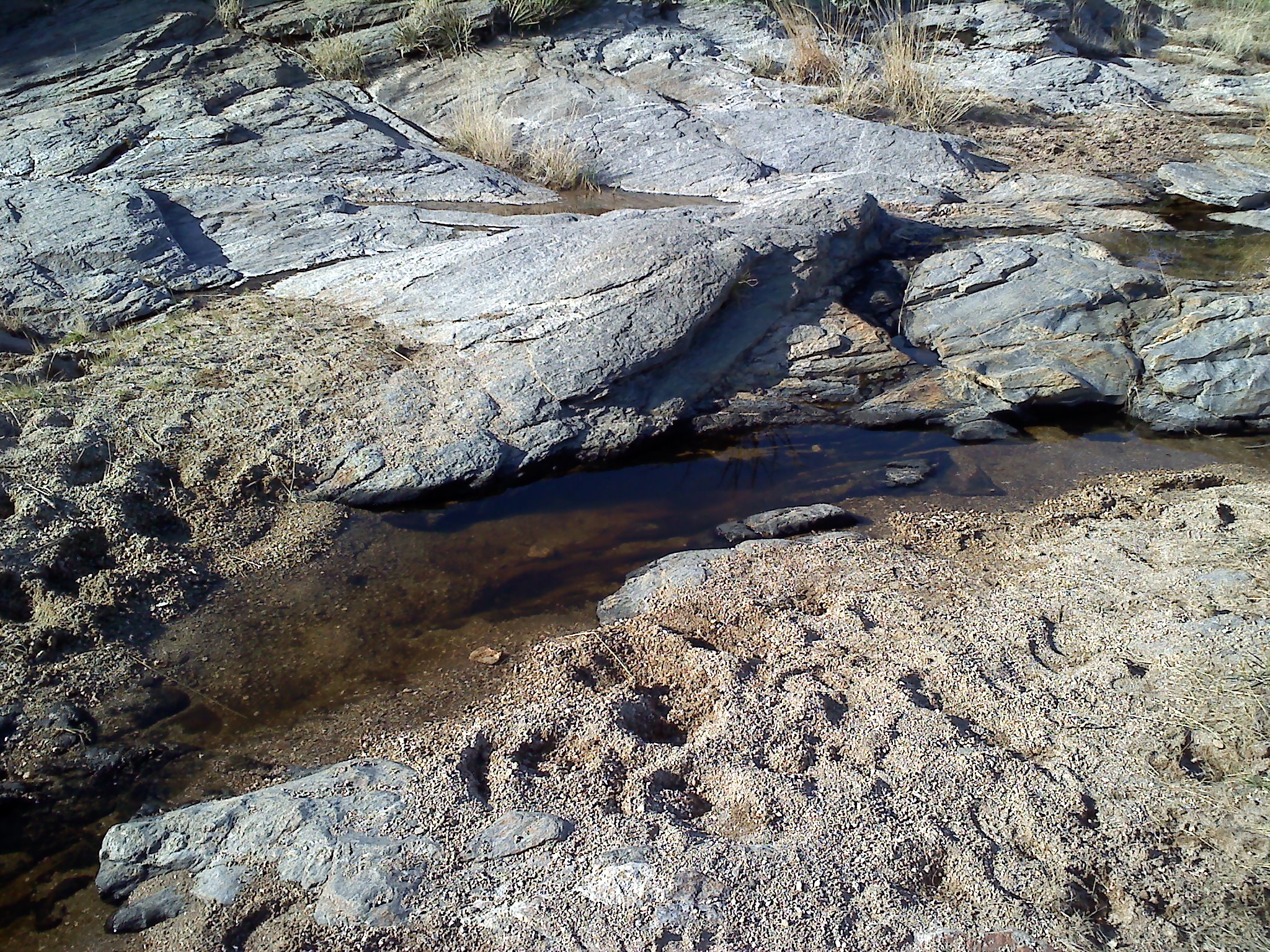
This is a mountain spring.

This is not a mountain spring.

20130429073452

Care to guess which one we drank from?

Fortunately, my water filter did its job well enough and prevented horrible giardia infections. Still, it was pretty gross to expect the flowing stream that I’d encountered on my previous hike and be confronted with a stagnant puddle that challenged me to relive all the best Survivorman episodes I’d ever watched. Even when I resupplied our water, I was still down to 50% of my intended carrying capacity, which meant I was running on empty almost immediately on the second day.

Anyway, this all added up to the fact that water was a huge issue for me during the entire trip and as a result, I was rocking a pretty good case of heat exhaustion and dehydration by the end of the trip, which contributed to my overall bleak mood. I’m glad that we toughed out the trip and I did have a good time. But it was more a result from what I achieved and was subjected to, rather than the aforementioned nature walk.

I’d be willing to tackle the Rincons again; I’ve yet to make it beyond the first camp and I want to see what else is out there. I have a feeling that there’s some pretty beautiful scenery hidden beyond its craggy borders. But for the meantime, I think the next trip will be something nice and restorative at good old Aravaipa Canyon.

Happiness Is Being An Aging Liberal

A friend (who also happens to be my most dedicated commentator) sent me a link to a new study on what makes us happy. Now, typically I approach such things with a bit of skepticism. It is, after all, common to see studies touting sample sizes of mere handfuls or studies lasting for very short lengths of time. Not this one, however! This study followed 268 men for seventy-five freaking years. That’s pretty damn impressive, in and of itself. Another impressive fact, aside from the length of the study, was the breadth of it:

. . . measuring an astonishing range of psychological, anthropological, and physical traits—from personality type to IQ to drinking habits to family relationships to “hanging length of his scrotum”—in an effort to determine what factors contribute most strongly to human flourishing.

Now that is some thorough research. I’ve honestly never wondered whether the “hanging length of the scrotum” might contribute, positively or negatively, to one’s level of happiness.

Some of the data proves what common sense already dictated: drinking is bad for your happiness, smoking kills you. Nice to have a scientific confirmation for these things, but nothing really earthshaking yet. Don’t worry, we’ll get to that bit soon.

It was interesting to me that “there was no significant difference in maximum income earned by men with IQs in the 110–115 range and men with IQs higher than 150.” It seems a little bit counter-intuitive, but if I might speculate, perhaps this is because the 110-115 range is the IQ most likely to have a decently paying job while individuals in the 150+ range are more likely to pursue intellectually stimulating professions that offer only comparable or inferior salaries. Like I said, this is speculation on my part; the study itself indicates that it is a higher number of “warm relationships” rather than IQ that contributes more towards high income and personal happiness.

For me, here’s the statistic that I found both the most interesting and also the most personally satisfying:

Aging liberals have more sex. Political ideology had no bearing on life satisfaction—but the most-conservative men ceased sexual relations at an average age of 68, while the most-liberal men had active sex lives into their 80s. “I have consulted urologists about this,” Vaillant writes. “They have no idea why it might be so.”

So while my liberal ideology won’t make me more satisfied with my life, it will mean I’ll likely have more sex. And while that might not lead to happiness on its own, I certainly can’t imagine where it’s going to hurt my chances at happiness. I don’t know about you, but this fact makes me feel a certain smug sense of satisfaction and vindication, which is not to say that I felt my beliefs needed vindication. It’s just one of those things.

If you’d like to find out the true cause of happiness, since it’s not a higher IQ or more sex, check out the article.

An Idealistic Thought For The Day

I know I linked to him in yesterday’s post about Romanticism, but I think David Brin really did have a point about the state of the world (beyond just the scope of Romanticism and the fantasy genre) and I wanted to highlight it in light of some other recent news.

From David Brin’s blog:

“. . . anyone who thinks we’ve gotten worse in our brutal savagery is simply a historical ignoramus.  I mean an ignoramus of historical proportions, who knows nothing of what the Assyrians did to the lost ten tribes of Israel, or the Romans to Judea, or the Mongols to Poland, or the Spanish to every native population they encountered. Or the Polynesians to each other, every year. Do you doubt that I could go on with this list? All day and all week? Can you cite counter-examples? Sure, but not many.

By comparison, . . . the per capita rate of violence on planet Earth has plummeted every single decade.

Don’t believe it? Watch this: Stephen Pinker on the Myth of Violence. Then ponder the most marvelous irony: that you think modernity is more violent and cruel only because modernity has succeeded in raising our standards of decent behavior, making us more self-critical about the travesties that remain.  Crimes that are so much milder than our ancestors committed routinely, without a twinge.”

It’s a good point to keep in mind. I know I fall victim to feeling like things are getting worse. It seems like every other day, some asshole from Tucson is making us all look bad. Or people are getting shot. Or blown up. Or blown up due to negligence. Anyway, it just feels like things are getting worse, even though, as Brin argues, the inverse is actually true.

That despair we’re feeling at the state of the world? That’s not the world descending into hell, that’s us getting more sensitive to the horrors that need our silent consent to continue unopposed. A generation ago, fuckwads like Tucson’s own Dean Saxton couldn’t be publicly shamed for his idiocy. Sure, that means he has a larger audience now and his message will reach more minds. It also means that more people will have an opportunity to say, “fuck you and fuck your ideas.” Contrary to popular belief, there is such a thing as bad publicity. The parts of you that exist on the Internet are eternal. These things have a way of sticking around. Maybe Saxton’s name will come up when he’s applying for a job and his fifteen minutes of fame will cost him. Or maybe this will be the greatest aspect of his legacy and this is how history will remember him, as a hateful misogynist swept aside by the changing times.

Silence and ignorance are the sanctuaries that breed cruelty the most effectively. Sure, it doesn’t make a big difference, calling out one asshole to a small audience on a wordpress blog (even if I did pay for my domain so you know that I’m hella serious). The effective change in the world won’t be felt today. Or tomorrow. Or next week. Or next year. I haven’t made the world any better by writing this post. Nobody saves the world by tweeting about it.

But if you get enough small changes? Over a long enough period?

Then you have enough change to erode mountains. Enough small changes together can move continents.

That’s what our technology is doing for us. It’s making us better by helping us to demand that the world be better. And in the mind of a better person, an injustice that was once ignorable is now intolerable. The world seems more intolerable today than it did yesterday because today we’re less willing to tolerate today what yesterday we could comfortably ignore.

Romanticism vs. Enlightenment

As you might infer from the title (you clever reader, you), lately I’ve been preoccupied with the concept of dueling themes. It seems like duality has been a feature of human thought forever. Light vs. dark, good vs. evil, etc. are common enough and certainly universal, but what about the more abstract oppositions? Thought vs. feeling, red vs. blue, law vs. chaos, and other less clear-cut themes are interesting to me because there is not obvious “right” answer. Good vs. evil is banal in the sense that no sane person truly believes that he or she is evil. A person who commits evil is usually certain of their own moral reasons for having done so, no matter how misguided. That, or they’re crazy.

Romanticism vs. Enlightenment is something that’s been on my mind ever since reading through that linked TV tropes page. I also read a post by David Brin that thoroughly denounces the fantasy genre, long a bastion of Romanticism, as “pining for Feudalism.” It all got me thinking and since I do my best thinking at a keyboard, here we are now.

Romanticism is one of those things that writers seem drawn to almost instinctively (unless you’re a science fiction writer). It just seems natural to want to be in the company of Poe, Shelley, Lord Byron, and countless others. All the talk about creativity just seems to fall right in line with the writer’s mindset. On the surface, I’d say I considered myself a Romanticist.

And I really, really like the aesthetic. I like the fantasy genre. I like swords and spells and dragons. I feel much more affinity for those tropes than any other. If such an opposition could be boiled down to two icons, it would be this: Star Wars (Romanticism) or Star Trek (Enlightenment)? I’m in the Star Wars camp.

Here’s the thing: I feel weird for choosing that side. When I think about my ideas and my world views, everything seems to push towards the Enlightenment side of the equation. A co-worker of mine, when posed this question today, said that she preferred the Enlightenment because she “views everything through the lens of feminism” and I found myself agreeing with her; it’s hard to embody feminism (or even the broader definition of humanism) without appealing to Enlightenment ideals.

So, which is it? Romanticism or Enlightenment? Perhaps it’s a foolish question, since a person is too complex to be boiled down to labels and broad definitions, but it seems that with enough consideration of the details, a general trend should emerge. It should be possible to identify one’s self as “leaning towards one” through an overall preference of one set of ideals, even if one does not enjoin all of them. And if these opposing themes are truly in opposition, it doesn’t seem feasible to say that one is “both.” At some point, a definition has to be made.

I do have a reason for why I ponder these things, unrelated as they might be to my larger existence. You know what they say about an examined life, yes? This is me examining my life and myself which should be an unsurprising endeavor for an introvert. I like to think that it’s possible to remove various mental contradictions and incongruousness from myself through the process of self-reflection. Perhaps this is to prevent hypocrisy of thought (a vegetarian who supports the death penalty? Wtf?) or perhaps it’s an attempt to live up to the skeptical ideal.

Maybe I’m over thinking it. All I know is that this is what’s going through my head at the moment.

Tabletop Gaming Weekend: Sunday Recap

For me, Sunday is the gaming day. Almost every week, we gather the troops to play Dungeons  & Dragons or Pathfinder (our current system). Every so often we’ll play another game like Arkham Horror, usually when the DM (me) isn’t feeling up to running a session. It seemed almost foolish to host a Pathfinder game after two solid nights of tabletop, but a DM has to have standards, you know? Even if those standards roughly amount to “being good enough at improv to keep up with the players and act like you meant to do this all along.”

I thought about calling off the game, I really did. Call me crazy, but it just seemed like it would be a mistake. Maybe I wanted to see if I could really go the distance, you know? Even if, in this case, the distance didn’t actually involve that much movement.

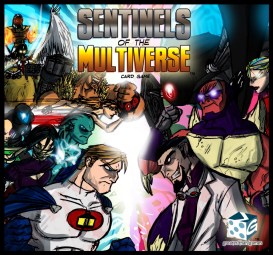
Well, to my surprise, we ended up canceling the Pathfinder game anyway due to being short a player, a player whose character had been killed and hadn’t rolled a new one yet, and still needing to level up after last session. With that bookkeeping out of the way, we decided to hold off on the game itself and play something in the meantime. That something turned out to be Sentinels of the Multiverse. (SotM)

Image

SotM is a cooperative card game where you take the role of different heroes and fight against a single villain, represented by its own deck that runs automatically. The characters are archetypal in the best comic book tradition. There’s the Wraith who’s basically a female Batman (but not Batgirl!). Absolute Zero is an ice-based guy with a backstory that manages to involve heroic blackmail (seriously, it’s “here’s a suit to survive your tragedy, now fight for good or we’ll repo that shit”). Fanatic is your winged angelic crusader with a huge sword and a “smite the evulz” complex. I ended up as Nightmist, the paranormal investigator who ended up tapping into dark powers and now wields those powers against evil. Like I said, classic. Fun fact: there’s a few very subtle references to H.P. Lovecraft and the Arkham Horror board game worked in there. I appreciated that. There was also a reference to my home city in the Wraith’s biography. You don’t see many shout-outs to Rochester, New York, so that made me happy, too.

Each deck plays differently, but the basic mechanic is that you can play one card per turn, activate one power (such as the one printed on your hero card) and draw one card at the end of your turn. The card interactions for Nightmist’s deck were pretty intricate; I could see right away why she was ranked as one of the more complex heroes to play. My deck involved buffing my damage dealing ability, then using my power to damage myself to draw more cards, then using my amulet card to redirect all the damage I’d done to myself towards an enemy instead. It was pretty fun.

With 18 different hero decks to play (this is including the expansions) and just as many villain decks, there’s a lot of variety here. The decks interact with each other in different ways; as Nightmist, I was able to generate card drawing for my allies which helped out a few times when things got rough.

There are two things that really make this game stand out. The first is that it’s a self-contained set, so unlike collectible card games like Magic: the Gathering, you don’t have to build your own deck which lowers the entry barrier considerably. Secondly, the decks all seem to be built with cooperation in mind, so there’s plenty of interaction among the heroes. It’ll be fun to see which decks work well together against which villains, since each villain deck is designed to play different and offer a different challenge.

We finished the game around 11:00 pm or so. It was at this point that I passed out on the couch, having imbibed just a little too much during the course of the evening. At some point, I staggered into bed.

All in all, it was an excellent weekend, if unintentional. It reminded me fondly of the undergrad days, where we’d play Magic or D&D well into the early hours of the morning. There was a certain abandon then, a certain idyllic sense. Of course, this was just the geek version of partying all night, which is why I didn’t end up going to many parties in college. But I wouldn’t trade it if given the choice.

However, I was very glad that I had today to recover from my weekend gaming binge and I don’t think I’ll be trying to repeat the experience any time soon. Once a week should be enough for me, I think.

At least for a while.

Tabletop Gaming Weekend: Saturday Recap

It wasn’t supposed to turn into this three-day thing, you know? Friday’s gaming was a spontaneous thing, the result of one James Walter and the colorful box he carried to a work meeting and then to dinner right after the meeting. It was just there, you know? We had to try it. I can’t be blamed for that.

Saturday, though. For Saturday, I don’t have the luxury of that excuse, because I was enticed purely by one sentence: “who wants to play Dominant Species?” The answer was me. I do. I want to play this game. This is how day two of the gaming binge got started.

dominantspecies

Dominant Species is a strategy board game where you take the role of one of five different groups of animals and try to survive the encroaching Ice Age. It plays similarly to a tabletop war game, except that there’s really no war to speak of beyond this hilariously awesome combination of dropping glaciers on people and competing for resources.

The animals on offer are mammals, reptiles, birds, arachnids, and insects. Each one has a special ability: mammals are highest on the food chain (and thus win ties) and can survive extinction events. Reptiles can resist regression (which otherwise takes away the adaptations you need to survive). Birds can migrate more spaces than other animals. Arachnids have a particularly insidious power: they can preemptively eliminate other animals during Competition; they’re like tiny venomous assassins. Insects go first during each turn and can reproduce like crazy.

This was my second time playing dominant species and both times, I’ve picked the reptiles. They’re not the most powerful species, in my opinion, but I’m loyal to my scaled brethren. The goal of the game is to spread out across the board (which is arranged during play by placing hexagonal tiles to represent new terrain) and accumulate victory points while trying to survive. The various ways you can be eliminated are starvation due to lack of resources or competition, where other animals kill you off.

The real charm of this game comes from the massive amount of strategy. Each turn plays like this: there is a section of the board divided up into phases, with each phase representing a different strategic option. You have a limited number of tokens that you can place in on the phases to pursue those strategies. Some a limited in number: only three people can select the Adaptation, for example. You won’t be able to do everything. Once everybody has placed their tokens, each phase is resolved and you see who lives, who dies, who reproduces, and who runs away to a lonely corner of the map and tries to hold onto “Snake Mountain” for the entire game while everybody else kills each other or gets glaciated.

The glacier mechanic is particularly fun. The game starts with the center hex covered in a glacier. Each turn, whoever is first in line on the  Glaciation phase gets to place a new glacier tile anywhere on the board as long as it touches at least one existing glacier. This glacier kills off all but one animal of each species on the tile and also removes necessary resources from the board. It’s very fun steering the glacier towards your opponents. It’s very frightening when they steer it back towards you.

There’s a lot more strategy that goes into the game and you have to balance a lot in order to win. If you specialize on one resource, you might die off if that resource vanishes. On the other hand, if you engage in too much competition, you might not dominate enough areas to earn points. There’s a lot going on.

The game does have a rather long set-up time and takes a while to play. We didn’t hit the actual endgame by midnight and just ended up calling the game. I think part of this is due to the fact that both games we played, we were learning (we were all new the first game and had one new player the second game). Once you “get it”, things go a lot faster.

It’s a more complex game than King of Tokyo or Cards Against Humanity, but this is a core tabletop experience. A huge board, a lot of pieces, a ton of strategy: this is the kind of game that you’ll come back to again and again. I like how perfectly it captures the feeling of trying to survive as resources go scare, land changes, and then your land is overwhelmed by venomous spiders. The competition mechanic is more passive than other war games, but that makes for a nice change of pace.

It took up my entire Saturday night, but when you get right down to it, a Saturday night playing Dominant Species is a Saturday well spent.